

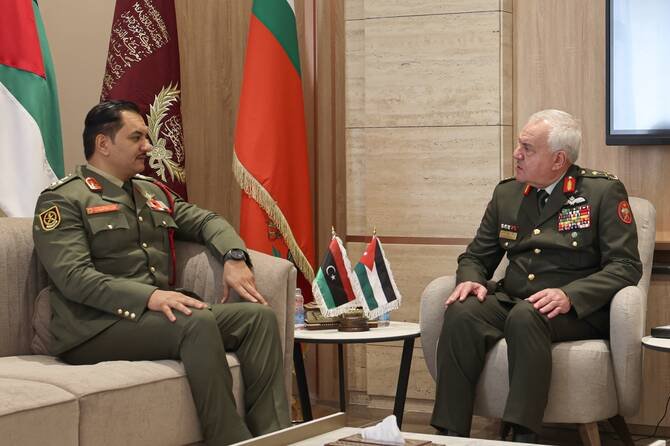
Amman: Senior military officials from Jordan and Libya met in Amman on Wednesday to explore avenues for joint cooperation, capacity building, and strategic coordination amid growing regional security challenges.
The meeting brought together Jordan’s Chairman of the Joint Chiefs of Staff, Maj. Gen. Yousef Huneiti, and Libya’s Deputy Commander-in-Chief, Lt. Gen. Saddam Khalifa Abu Qasim. The discussions focused on strengthening military partnerships, sharing expertise, and expanding training programs between the two countries.
According to Petra news agency, Maj. Gen. Huneiti outlined Jordan Armed Forces’ key modernization programs, including advanced training, operational preparedness, and humanitarian initiatives in the West Bank and Gaza Strip. He emphasized that Jordan prioritizes military cooperation not only to enhance national defense but also to safeguard regional stability and mutual interests.
Our objective is to build stronger ties with friendly nations, share knowledge, and collectively address security challenges that affect the region, Huneiti said.
Lt. Gen. Abu Qasim underscored the importance of continuous coordination and the exchange of military expertise. He noted that joint training and capacity-building initiatives would help both countries strengthen defense capabilities and respond effectively to emerging threats.
Analysts say the meeting reflects broader efforts in the Middle East and North Africa to enhance collaboration among allied nations in a volatile security environment. Jordan has increasingly positioned itself as a hub for military cooperation, leveraging its experience in training, counterterrorism, and regional peacekeeping missions. Libya, emerging from years of internal conflict, is seeking international partnerships to bolster its armed forces and stabilize national security.
The Amman talks come at a time when both countries face overlapping security challenges, including border security, the threat of extremist groups, and the need for professionalized military forces. Observers say structured cooperation between Jordan and Libya could serve as a model for broader regional collaboration.
This meeting demonstrates a shared commitment to security, modernization, and knowledge exchange, and lays the groundwork for a long-term strategic partnership, Petra reported.
Officials from both countries agreed to continue discussions, with joint training programs, military exchanges, and operational coordination high on the agenda. The dialogue also signals a step toward strengthening ties between North Africa and the Levant in addressing common security concerns.