

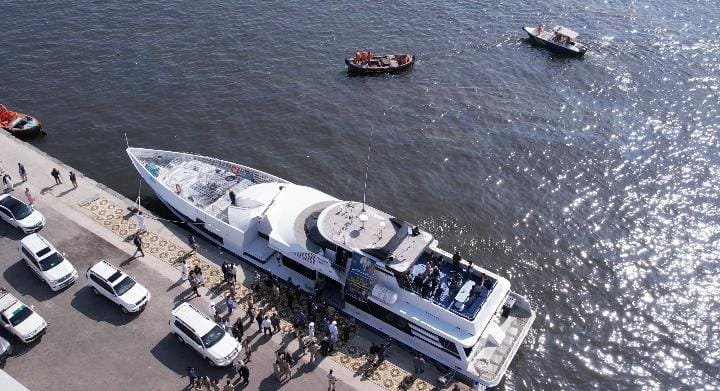
Pakistan has taken a significant step toward reshaping its maritime landscape by formally entering the field of coastal passenger transport, an area that had remained unexplored despite the country’s long coastline and strategic location. In a move being described as historic, the government has launched the country’s first licensed ferry service framework and opened a dedicated passenger ferry terminal at Karachi Port, signaling the beginning of a new chapter in maritime tourism and regional connectivity.
The inauguration ceremony at Karachi Port was led by Federal Minister for Maritime Affairs Muhammad Junaid Anwar Chaudhry, who emphasized that passenger ferry operations are expected to begin within the coming weeks. Addressing officials, industry representatives, and port authorities, the minister highlighted that this initiative reflects a broader shift in national policy aimed at diversifying maritime activities beyond traditional cargo handling.
For decades, Pakistan’s maritime sector has largely revolved around commercial shipping, port operations, and cargo movement. Although the country has a coastline stretching over a thousand kilometers along vital regional sea routes, the concept of licensed coastal passenger transport had never materialized. Experts often attributed this absence to outdated regulations, a lack of structured policy, and limited engagement from private investors. The newly introduced licensing mechanism is intended to remove these long-standing barriers by allowing private operators to offer ferry services under a regulated and transparent framework.
Officials involved in the project described the opening of the Karachi passenger ferry terminal as a landmark moment, not only because it marks the launch of a new mode of transport, but also because it lays the groundwork for a potentially transformative tourism and trade ecosystem. According to the maritime affairs ministry, the terminal is designed to support future passenger routes connecting Pakistan with neighboring coastal destinations, including Iran and countries in the Gulf region.
Although the terminal has now been formally inaugurated, the regulatory groundwork was laid earlier. Pakistan issued its first-ever ferry service license in August 2025, effectively opening the door for passenger ferry routes for the first time in the country’s history. Since then, the government has been working to translate policy into practice by developing infrastructure, finalizing operational guidelines, and coordinating with port authorities to ensure safety and efficiency.
Speaking at the event, Minister Chaudhry described the ferry initiative as far more than a transport project. He noted that the introduction of ferry services has the potential to unlock a wide range of economic opportunities by supporting tourism, enhancing regional connectivity, and encouraging cross-border people-to-people interaction. He added that coastal and maritime tourism could become a new growth area, especially if supported by modern infrastructure and private-sector innovation.
The government’s renewed focus on maritime development is closely tied to its promotion of the “blue economy,” a concept that has gained international attention in recent years. The blue economy emphasizes sustainable use of ocean resources for economic growth, job creation, and environmental protection. In Pakistan’s context, officials believe that passenger ferry services could serve as a catalyst for this broader vision by stimulating activity in coastal areas, creating employment, and generating demand for hospitality, transport, and related services.
According to the maritime affairs ministry, the issuance of the first ferry license has already generated interest from additional investors. Several private entities have reportedly approached authorities to explore opportunities in passenger transport, cruise-style services, and short-distance coastal routes. This early response is being seen as an encouraging sign that confidence in Pakistan’s maritime reforms is beginning to build within the private sector.
Minister Chaudhry also indicated that the government is actively working to strengthen collaboration between public institutions and private operators. Discussions are underway with port authorities to expand infrastructure at key locations, streamline regulatory processes, and establish public-private partnership models that can attract long-term investment. The aim, officials say, is to ensure that ferry services are commercially viable while meeting safety, environmental, and service standards.
Beyond passenger transport, the maritime affairs ministry is also linking ferry services to broader industrial and trade goals. During his remarks, the minister revealed that the Port Qasim Authority is preparing to announce plans for a new industrial zone. This initiative is part of a wider strategy to integrate port development with industrial growth, exports, and logistics, thereby maximizing the economic potential of Pakistan’s coastal assets.
Analysts note that the launch of ferry services could gradually change how coastal travel is perceived in Pakistan. In many countries, ferries play a key role in connecting cities, islands, and neighboring states, offering an affordable and efficient alternative to air and road transport. If successfully implemented, Pakistan’s ferry system could eventually support domestic coastal routes as well as international services, opening new avenues for trade and tourism.
The government acknowledges that challenges remain, including the need to build passenger confidence, ensure maritime safety, and develop supporting services. However, officials insist that the combination of regulatory reform, infrastructure development, and private-sector engagement provides a strong foundation for sustainable growth.
The inauguration of the Karachi passenger ferry terminal and the rollout of Pakistan’s first licensed ferry service framework represent a decisive move toward modernizing the country’s maritime sector. By shifting focus from cargo-only operations to a more diversified model that includes passenger transport and tourism, Pakistan is positioning itself to better leverage its coastline, attract investment, and participate more actively in regional maritime networks.