

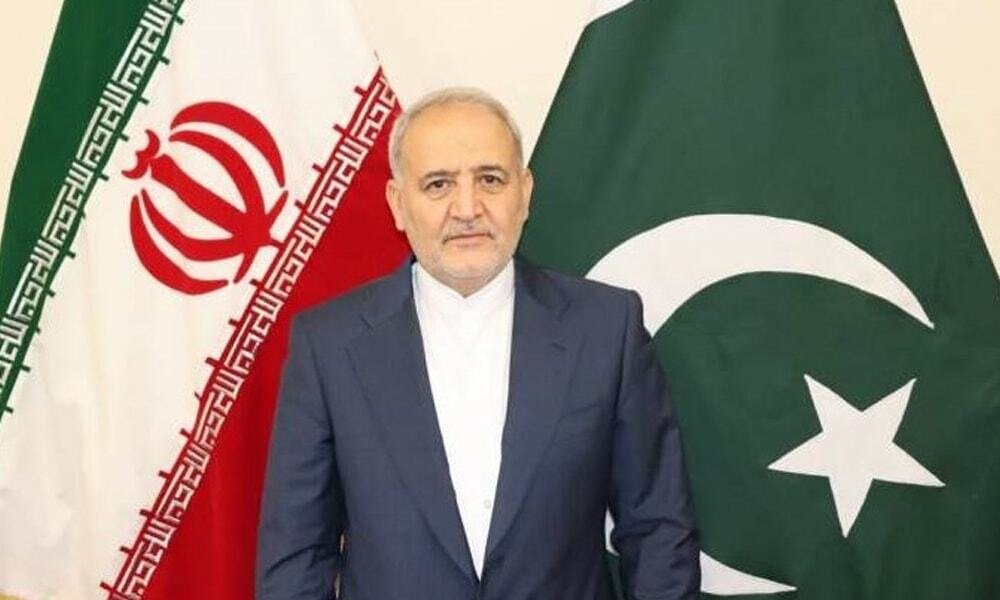
Recent diplomatic developments at the United Nations Human Rights Council in Geneva have drawn significant attention across regional and international political circles, particularly following Pakistan’s decision to take a clear and principled stance in support of Iran. In this context, Iran’s Ambassador to Pakistan, Reza Amiri Moghaddam, publicly expressed profound gratitude toward Islamabad, describing Pakistan’s position as a rare example of moral clarity and independence in an increasingly polarized global environment.
According to the Iranian envoy, Pakistan’s conduct at the Human Rights Council went far beyond routine diplomatic protocol. At a time when political pressure, strategic alignments, and external influence often shape voting behavior at international forums, Pakistan chose to act in accordance with its own principles rather than yielding to dominant geopolitical narratives. Ambassador Moghaddam emphasized that this decision reflected Pakistan’s commitment to justice, sovereignty, and the genuine spirit of multilateralism.
The focal point of the ambassador’s remarks was Pakistan’s vote against a resolution that targeted Iran on alleged human rights concerns. He noted that the resolution was presented in a manner that lacked balance and objectivity, arguing that it relied on selective information and politically motivated interpretations rather than an impartial assessment of facts. In his view, such resolutions undermine the credibility of international institutions by transforming them into tools for political pressure rather than platforms for constructive dialogue.
Reza Amiri Moghaddam highlighted that Pakistan not only opposed the resolution but also supported the demand for a formal vote, a move he described as both bold and principled. He explained that calling for a vote in such circumstances requires diplomatic courage, as it exposes a country to political backlash and potential diplomatic costs. However, Pakistan’s leadership, he said, demonstrated that adherence to ethical standards and international fairness outweighed any short-term considerations.
The Iranian ambassador reserved particular praise for Pakistan’s political leadership, acknowledging the role played by Prime Minister Shehbaz Sharif and Deputy Prime Minister and Foreign Minister Ishaq Dar. He stated that under their guidance, Pakistan has consistently projected a foreign policy rooted in balance, restraint, and respect for international law. According to him, the leadership’s approach reflects a mature understanding of global affairs and a willingness to uphold principles even in complex and sensitive situations.
Ambassador Moghaddam further asserted that the resolution against Iran was part of a broader pattern of political maneuvering aimed at exerting pressure through international institutions. He argued that some states have increasingly sought to instrumentalize human rights mechanisms to advance narrow strategic objectives, often ignoring similar issues elsewhere. This selective approach, he said, not only weakens the legitimacy of human rights advocacy but also erodes trust in global governance structures.
He pointed out that the latest attempt to push an anti-Iran resolution marked the third consecutive failure of such initiatives. Over recent years, he explained, Iran has faced repeated efforts to isolate it diplomatically through coordinated political campaigns, media narratives, and international lobbying. Despite these sustained efforts, each attempt has failed to secure broad-based international consensus, highlighting the growing skepticism toward politicized resolutions.
The ambassador referred to what he described as a period of intensified pressure against Iran, including a 12-day phase of aggression, externally supported unrest, and continuous attempts to manipulate global institutions. According to him, these measures were designed to weaken Iran’s position on the international stage but ultimately failed due to lack of legitimacy and international support. Pakistan’s recent stance, he said, was instrumental in reinforcing this outcome.
In linking Pakistan’s position to broader global principles, Reza Amiri Moghaddam emphasized the importance of national sovereignty and equality among states. He remarked that Pakistan’s vote sent a powerful signal that sovereignty cannot be compromised through politically driven resolutions and that all nations, regardless of size or power, deserve equal treatment under international law. This message, he added, carries particular significance at a time when unilateralism and coercive diplomacy are increasingly prevalent.
The Iranian envoy also framed Pakistan’s decision as a meaningful contribution to the authentic interpretation of human rights. He argued that genuine human rights advocacy must be comprehensive, impartial, and free from political bias. It should aim to promote dialogue, reform, and cooperation rather than punishment and isolation. Pakistan’s opposition to the resolution, he said, aligned with this broader and more constructive understanding of human rights.
Beyond the immediate diplomatic implications, Ambassador Moghaddam highlighted the positive impact of Pakistan’s stance on bilateral relations between the two neighboring countries. He noted that Iran and Pakistan share deep historical, cultural, and religious ties, as well as overlapping perspectives on many regional and international issues. Pakistan’s support at the Human Rights Council, he said, reinforced mutual trust and demonstrated the strength of this longstanding relationship.
He expressed optimism that such principled alignment would pave the way for deeper cooperation in the future, not only at international forums but also in economic, regional security, and diplomatic initiatives. According to him, when neighboring countries support each other on the basis of shared values rather than temporary interests, it creates a foundation for sustainable and resilient partnerships.
In his concluding remarks, Reza Amiri Moghaddam stated unequivocally that Iran would always remember Pakistan’s consistent and principled support with respect and appreciation. He described Pakistan’s decision as one of those defining diplomatic moments that transcend procedural voting and leave a lasting imprint on bilateral relations. Such actions, he said, are recorded not only in official documents but also in the collective memory of nations.
The ambassador further expressed confidence that Pakistan would continue to advocate for justice, fairness, and the integrity of multilateral institutions in future international engagements. He noted that in an era marked by geopolitical rivalries and shifting alliances, voices that defend principles over power are increasingly rare yet critically important.
Ultimately, the developments in Geneva underscored a broader message: that principled diplomacy remains possible even in a complex and divided world. Pakistan’s stance demonstrated that adherence to justice, respect for sovereignty, and commitment to multilateralism can still shape international outcomes. For Iran, this support represented not merely a diplomatic gesture, but a reaffirmation of shared values and mutual respect that will continue to influence relations between the two countries in the years to come.