

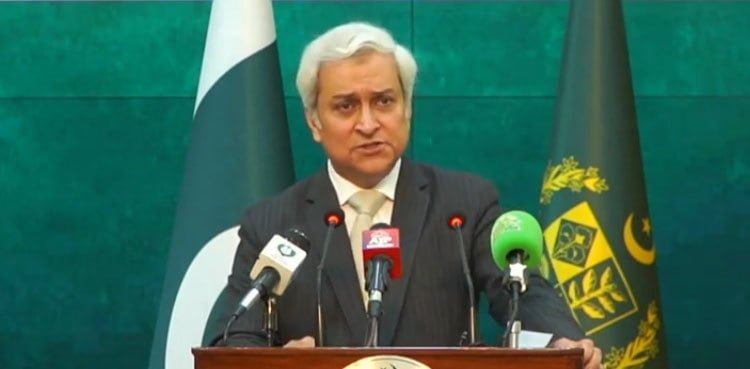
Pakistan has made it explicitly clear that it will not become a part of the Abraham Accords and that linking the recently formed “Board of Peace” to the Abraham agreement is a misunderstanding. This was emphasized by the Foreign Office spokesperson, Tahir Hussain Inderabi, during his weekly briefing in Islamabad, where he outlined Pakistan’s foreign policy stance and its ongoing efforts to contribute to global peace initiatives, particularly concerning the situation in Gaza and Palestine.
Inderabi underscored that Pakistan’s participation in the Board of Peace was undertaken with the sole intention of promoting stability in Gaza, facilitating reconstruction efforts, and supporting a long-term peace framework based on the Palestinian people’s right to self-determination. He clarified that Pakistan has made no decision to join the Abraham Accords or any international stabilization force, and it does not intend to do so.
According to the spokesperson, Pakistan’s decision to engage with the Board of Peace is grounded entirely in goodwill and humanitarian considerations. The Board, he explained, serves multiple objectives: first, to reinforce and maintain the ceasefire in Gaza; second, to assist in the reconstruction of the region, which has suffered extensive destruction over the past two years; and third, to work toward the establishment of enduring peace based on the legitimate rights and aspirations of the Palestinian people. Inderabi emphasized that Pakistan’s involvement is designed to be constructive and supportive, aimed at providing practical assistance rather than merely participating in symbolic diplomacy.
He further highlighted that Pakistan is not acting alone in these efforts. The Board of Peace includes seven other Muslim-majority countries, namely Saudi Arabia, Egypt, Jordan, the United Arab Emirates, Indonesia, and Qatar. The formation of the Board in September of the previous year was a collective initiative, designed to provide a unified platform for countries to work together to alleviate the humanitarian and political crisis in Gaza. Inderabi described the Board as a “beacon of hope” for Gaza and for the wider Palestinian issue, emphasizing that its purpose is to create tangible results on the ground rather than to replace existing international mechanisms.
He made it clear that the Board operates as a complementary platform to the United Nations, with the backing of the UN Security Council, ensuring that its work aligns with broader global peacekeeping and humanitarian frameworks.
Addressing the ongoing humanitarian crisis in Gaza, Inderabi noted that for the past two years, civilians have endured severe destruction, displacement, and a critical shortage of basic necessities. He pointed out that efforts by the United Nations to halt Israeli aggression have largely failed, which underscores the importance of alternative, cooperative mechanisms such as the Board of Peace. Through this platform, countries can coordinate aid, reconstruction, and stabilization efforts more effectively, aiming to provide immediate relief while simultaneously addressing longer-term political solutions.
During the briefing, Inderabi also touched on issues concerning international travel and U.S.-Pakistan relations. He assured that Pakistan remains an open and secure country for international travelers. Regarding the recent U.S. travel advisory, he clarified that the updated guidance should not be viewed as a downgrade; rather, it reflects an updated assessment of security conditions.
Certain previous security points were removed from the advisory, making travel for U.S. citizens to Pakistan even easier than before. He emphasized that Pakistan and the United States remain in close diplomatic contact to ensure that these travel advisories provide accurate information and facilitate smoother movement for travelers from both countries.
In addition, the spokesperson discussed ongoing talks regarding U.S. visa restrictions on Pakistani citizens. He said that discussions are active both in Islamabad and Washington, and Pakistan remains hopeful that it will soon be removed from the list of visa restrictions. Diplomatic engagement with the United States continues with this goal in mind, aiming to normalize travel and strengthen bilateral ties. Inderabi underscored that Pakistan’s approach remains consistent: all actions and negotiations are guided by national interests, humanitarian principles, and the goal of enhancing people-to-people contact between the two countries.
Returning to the Board of Peace, Inderabi elaborated that Pakistan’s involvement is a direct reflection of its commitment to global humanitarian values. Through this platform, Pakistan seeks to contribute not only politically but also practically, coordinating with other member states to provide aid, implement reconstruction projects, and support efforts aimed at mitigating the suffering of Gaza’s population. He stressed that the Board’s objectives are concrete and operational, focusing on actionable steps to alleviate the humanitarian crisis and create conditions for sustainable peace. Unlike purely diplomatic forums, the Board encourages active collaboration, resource mobilization, and the implementation of tangible projects for the benefit of affected populations.
Inderabi also reaffirmed that the Board of Peace should not be conflated with the Abraham Accords or other international stabilization initiatives. Pakistan’s participation is entirely separate and is intended solely to address the ongoing humanitarian and political challenges in Gaza and Palestine. ]
The country remains committed to maintaining its independent foreign policy and will not allow its engagement in humanitarian or peacebuilding initiatives to be misconstrued as alignment with unrelated geopolitical agreements. Pakistan’s focus, he emphasized, is on providing meaningful support to the Palestinian people, promoting regional stability, and contributing to international humanitarian efforts.
The spokesperson highlighted that Pakistan’s approach within the Board of Peace is collaborative. Its representatives work closely with counterparts from other member states to ensure that assistance reaches those most in need and that reconstruction and stabilization projects are implemented efficiently. By working in concert with Saudi Arabia, Egypt, Jordan, the UAE, Indonesia, and Qatar, Pakistan seeks to maximize the impact of collective efforts and ensure that aid is not only delivered but also effectively managed. Inderabi emphasized that these cooperative measures are critical in a region where longstanding conflicts have led to recurring crises.
Addressing the broader geopolitical context, Inderabi clarified that Pakistan is committed to a principle-based foreign policy. Participation in multilateral initiatives such as the Board of Peace is motivated by humanitarian imperatives and the goal of promoting regional and international stability. Pakistan’s stance reflects a careful balance between engagement in practical peacebuilding efforts and maintaining sovereign decision-making regarding strategic alliances and international agreements. The country’s policy is shaped by both moral responsibility and national interest, ensuring that involvement in global initiatives aligns with its long-term vision for peace and development in the region.
Finally, Inderabi emphasized that Pakistan’s diplomatic efforts are ongoing and multifaceted. In addition to humanitarian work, Pakistan engages with international partners to address security, development, and governance challenges in conflict-affected areas.
Its participation in the Board of Peace is one component of a broader strategy to contribute constructively to the international community, demonstrating leadership and responsibility in matters of regional peace and stability. He reiterated that Pakistan’s involvement in these initiatives is independent, focused on humanitarian outcomes, and separate from any agreements or alliances unrelated to the core objectives of the Board.
Pakistan’s position is clear and consistent: it is a proactive member of the Board of Peace, dedicated to supporting Gaza and the Palestinian people through humanitarian aid, reconstruction, and the promotion of long-term peace. At the same time, it will not participate in the Abraham Accords or any unrelated international stabilization forces.
Pakistan’s engagement reflects its commitment to principled diplomacy, humanitarian action, and regional stability, and the country continues to coordinate closely with other member states to ensure that the Board of Peace achieves tangible results for those most affected by conflict and crisis.