

Pakistan and Uzbekistan are moving toward a new phase of strategic and economic partnership following an intensive round of engagements held in Islamabad during Uzbek President Shavkat Mirziyoyev’s two-day official visit. The visit, marked by extensive diplomatic, economic, and defense-related interactions, resulted in the signing of 28 memoranda of understanding (MoUs) and bilateral agreements, signaling a clear intent by both countries to expand cooperation across multiple sectors.
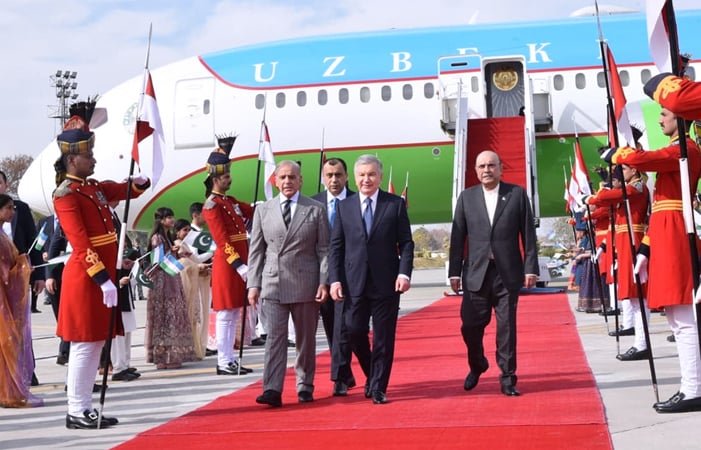
President Mirziyoyev arrived in Pakistan on Thursday evening accompanied by a large delegation comprising senior government officials, business leaders, and policy experts. His arrival underscored the growing importance both sides attach to strengthening ties between South Asia and Central Asia. Upon landing at Nur Khan Airbase in Islamabad, the Uzbek president received a ceremonial red-carpet welcome. Pakistan’s top leadership, including President Asif Ali Zardari, Prime Minister Shehbaz Sharif, and several cabinet members, were present to receive him, reflecting the high priority Islamabad places on relations with Tashkent.
One of the most significant highlights of the visit was the formal exchange ceremony of 20 out of the 28 agreements, conducted in Islamabad between senior ministers and officials from both countries. These documents collectively outline a broad framework for collaboration in areas considered vital for long-term regional development and mutual economic growth.
The agreements span a wide range of fields, demonstrating the multidimensional nature of the partnership. They include cooperation in *defense and security, joint efforts to address **climate change, mechanisms for **disaster risk reduction and emergency management, and enhanced collaboration in **agriculture and food security.
Additional protocols focus on **sanitary and phytosanitary standards, particularly aimed at facilitating the export of fruits and agricultural produce. Other areas covered include **mining and geosciences, **combating narcotics trafficking, and the *transfer of sentenced persons, reflecting both countries’ shared concerns about security, sustainability, and legal cooperation.
Following the signing ceremony, Prime Minister Shehbaz Sharif addressed the media in televised remarks, emphasizing Pakistan’s commitment to ensuring that the agreements translate into practical outcomes. He noted that both governments are aligned on promoting economic interests across a wide spectrum of industries.
According to the prime minister, sectors such as agriculture, pharmaceuticals, textiles, tourism, information technology, and value-added manufacturing will be given special attention. He stressed that Pakistan sees Uzbekistan not merely as a bilateral partner but as a gateway to broader Central Asian markets, while Uzbekistan views Pakistan as a vital route to global trade through its seaports.
A major focal point of the discussions was the Uzbekistan–Afghanistan–Pakistan (UAP) Railway Project, which both sides described as a transformative initiative for the region. The proposed railway corridor aims to connect Uzbekistan with Pakistan via Afghanistan, creating a direct and cost-effective trade route for landlocked Central Asian states to access international markets.
Prime Minister Sharif characterized the project as a potential “game-changer,” stating that it could reshape regional connectivity by integrating supply chains across Central and South Asia. He reaffirmed Pakistan’s readiness to work closely with Uzbekistan to mobilize financial resources for the project, emphasizing that both countries are prepared to pursue international funding based on feasibility studies and commercially viable business models.
He further noted that the railway initiative aligns with a shared vision of regional integration, economic interdependence, and long-term stability. By improving transit infrastructure, the project is expected to boost trade volumes, reduce transportation costs, and create new economic opportunities for countries along the route.
Beyond economic and infrastructure-related engagements, President Mirziyoyev’s visit also carried strong symbolic and academic significance. In recognition of his efforts to strengthen bilateral relations and promote regional cooperation, Pakistan’s National University of Sciences and Technology (NUST) conferred upon him an honorary Doctorate of Philosophy degree along with the honorary title of professor. The gesture highlighted the growing people-to-people and institutional connections between the two nations.
Defense and industrial cooperation also featured prominently during the visit. The Uzbek president, along with his delegation, toured the facilities of Global Industrial & Defense Solutions (GIDS) in Islamabad, a state-owned defense conglomerate of Pakistan. The visit offered the Uzbek side an in-depth look at Pakistan’s expanding indigenous defense manufacturing capabilities.
Pakistan’s Chief of Defense Forces, Field Marshal Syed Asim Munir, personally welcomed the delegation during their tour of the facility. Officials briefed the visitors on GIDS’ diverse portfolio, which includes advanced defense technologies, industrial solutions, and innovation-driven manufacturing processes. According to Pakistan’s military media wing, the delegation observed a range of defense products that reflect Pakistan’s progress toward self-reliance in defense production and industrial development.
The visit to GIDS underscored the potential for future collaboration in defense manufacturing, technology transfer, and industrial partnerships, areas where both countries see opportunities for mutual benefit.
In recent years, Pakistan and Uzbekistan have steadily worked to deepen economic engagement, driven by Islamabad’s broader strategy to position itself as a regional transit and trade hub linking South Asia with Central Asia. For Uzbekistan, which is landlocked, Pakistan’s ports offer a critical gateway to global markets, while Pakistan sees Central Asia as a key destination for exports, energy cooperation, and investment.
This evolving partnership builds on earlier milestones. Pakistan was the first South Asian partner with which Uzbekistan signed a bilateral *Transit Trade Agreement, followed by a *Preferential Trade Agreement (PTA) in March 2022. The PTA initially covered 17 selected items and became operational in 2023, laying the groundwork for increased trade volumes and reduced tariff barriers.
The latest set of agreements signed during President Mirziyoyev’s visit reflects a clear intention by both governments to move beyond symbolic diplomacy toward practical, result-oriented cooperation. By focusing simultaneously on trade, infrastructure, defense, climate resilience, and human development, Pakistan and Uzbekistan appear determined to craft a long-term partnership capable of withstanding regional and global uncertainties.
As both countries look ahead, the emphasis now shifts to implementation. Officials on both sides have expressed confidence that sustained political will, institutional coordination, and private-sector involvement will be crucial in turning these agreements into tangible economic and strategic gains—not only for Pakistan and Uzbekistan, but for the wider region they aim to connect.