

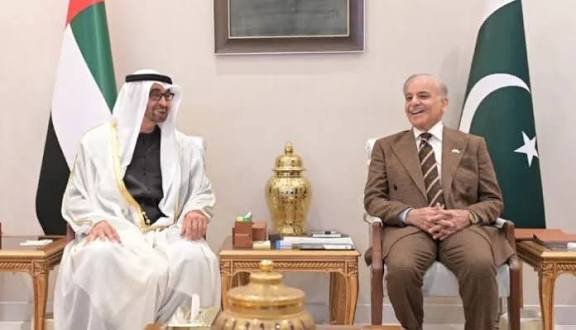
As Pakistan moves closer to another critical round of discussions with the International Monetary Fund (IMF), fresh diplomatic and financial coordination has resulted in temporary relief on the external financing front. The United Arab Emirates has agreed to extend the maturity of a $2 billion deposit placed with Pakistan for a short period of two months, providing Islamabad with breathing space ahead of key economic negotiations.
The deposit, which is part of a broader $3 billion arrangement placed with the State Bank of Pakistan by the Abu Dhabi Fund for Development, was approaching maturity when Pakistani authorities initiated high-level engagement with Emirati counterparts. Deputy Prime Minister and Foreign Minister Ishaq Dar personally reached out to senior officials in the UAE earlier this week to secure the extension. Following these contacts, the Emirati side conveyed its agreement to roll over the $2 billion amount until April 17, 2026.
According to senior officials familiar with the matter, the rollover has been approved at an interest rate of 6.5 percent on a short-term basis. While procedural formalities and written confirmation from the relevant Emirati authorities were still awaited at the time of reporting, government sources indicated that the approval was expected imminently and that the understanding had effectively been reached.
This development comes at a particularly sensitive time for Pakistan’s economy. Islamabad is preparing for the third review under the $7 billion Extended Fund Facility (EFF) agreed with the IMF. Successful completion of the review would unlock the release of a $1 billion fourth tranche under the programme. Demonstrating external financing stability is a key requirement in such reviews, and the continuation of friendly countries’ deposits plays an important role in strengthening Pakistan’s foreign exchange position.
Previously, the UAE had rolled over the same $2 billion for only one month after its maturity earlier this year. Of the total amount, one $1 billion tranche matured on February 16 and the second on February 22. Both were granted short extensions at the time. A third tranche of $1 billion under the UAE arrangement is scheduled to mature in July 2026, and officials have indicated that discussions regarding its rollover will be initiated closer to that date.
Pakistan had initially requested a much longer extension, seeking a two-year rollover of the funds. When that proposal did not receive immediate approval, Islamabad submitted a revised request for a longer-term arrangement after the short extensions were granted. Authorities have communicated to the UAE that once the IMF review is completed, Pakistan will formally approach Emirati officials again to pursue a more extended rollover of the deposits.
The Foreign Office spokesperson, when asked about discussions that reportedly took place during a meeting of the parliamentary Standing Committee on Finance, stated that he was not fully aware of the details presented there by officials from the Ministry of Finance. However, he confirmed that the deputy prime minister had been actively engaged on the issue and was coordinating closely with the relevant Emirati authorities. He emphasized that the duration of any rollover ultimately rests with the depositor and that the continuation of the facility indicated positive cooperation between the two sides.
The spokesperson further noted that as long as the rollover remains in place, the matter is considered manageable. He also referenced public remarks by the finance minister asserting that Pakistan does not currently face an external financing gap in light of its engagement plan with the IMF and commitments from bilateral partners.
In December, Pakistan’s Ministry of Finance had prepared detailed working papers and drafted formal correspondence requesting that the UAE roll over the entire $3 billion deposit for a period of one year. Officials had hoped to secure advance confirmation similar to arrangements made in previous years. However, at that time, the Emirati authorities agreed only to a limited one-month extension, prompting continued negotiations.
Parliamentary oversight of the issue intensified last week when officials from the Ministry of Finance were unable to provide categorical assurances to lawmakers regarding the full $3 billion rollover. Responsibility for diplomatic engagement was attributed to the Ministry of Foreign Affairs. In response, the finance minister informed the committee that Pakistan had already shared a comprehensive external financing strategy with the IMF and that bilateral discussions with the UAE were ongoing. He maintained that existing arrangements with partner countries remained on track and that any significant developments would be formally communicated.
The $3 billion placed by the UAE through the Abu Dhabi Fund for Development is structured in three separate tranches of $1 billion each. Two of these tranches matured in January—on the 17th and the 23rd—and were rolled over for one month at that time. The latest two-month rollover effectively extends the maturity of $2 billion further into April 2026. The remaining $1 billion tranche, due in July 2026, will be addressed separately as its maturity date approaches.
Pakistan’s reliance on deposit rollovers from friendly countries is part of a broader strategy to manage its external account obligations during the current fiscal year. Officials estimate that approximately $12 billion in foreign deposits require rollover or extension during this period. This includes around $9 billion from Saudi Arabia and China—roughly $5 billion from Riyadh and $4 billion from Beijing—along with the $3 billion held by the UAE.
In this context, Saudi Arabia has already provided some reassurance. In December, Riyadh agreed to extend the maturity of its own $3 billion deposit with the State Bank of Pakistan by an additional year. That placement originated under a 2021 bilateral agreement aimed at supporting Pakistan’s foreign exchange reserves.
For Islamabad, maintaining these deposits is critical not only for reserve stability but also for demonstrating credibility to international lenders. The IMF typically requires firm commitments regarding external financing before approving programme reviews and disbursing tranches. Continued support from partner countries such as the UAE, Saudi Arabia, and China strengthens Pakistan’s negotiating position and signals confidence in its reform trajectory.
While the two-month rollover from the UAE falls short of the longer-term extension originally sought, it provides immediate relief and avoids any sudden outflow from foreign reserves. Officials appear optimistic that once the IMF review is successfully concluded and macroeconomic indicators show further stabilization, discussions for a longer rollover period may yield more favorable terms.
For now, the focus remains on completing the IMF review and securing the forthcoming $1 billion tranche under the Extended Fund Facility. The government maintains that its external financing plan is intact and that coordination with bilateral partners continues at the highest levels. The temporary extension granted by the UAE represents another step in Pakistan’s ongoing effort to navigate its external obligations while pursuing economic stabilization and reform.