

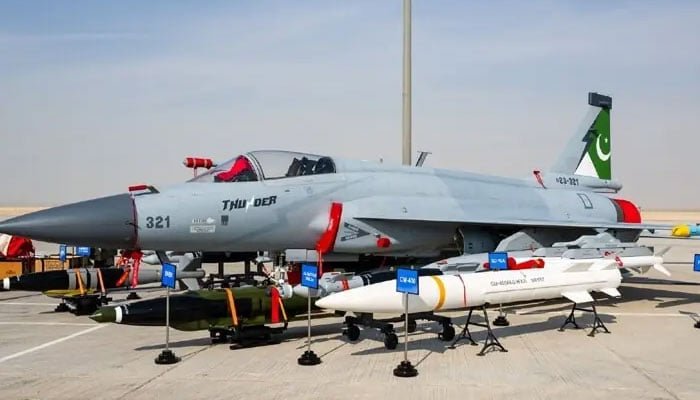
A major shift may soon unfold in the Horn of Africa’s security architecture as Somalia moves to rebuild an air combat capability that has remained dormant for more than three decades. After years of relying heavily on external partners for aerial surveillance and strike support, Mogadishu is now actively pursuing a plan that could fundamentally transform its military posture.
At the center of these efforts is a proposed acquisition of up to 24 JF-17 Thunder Block III fighter aircraft from Pakistan—a development that, if finalized, would mark Somalia’s most significant defense procurement initiative since the collapse of its central government in 1991.
The renewed momentum behind this initiative gained visible traction in February 2026, when Somali Air Force Commander Mohamud Sheikh Ali traveled to Islamabad for high-level consultations. That visit underscored both the urgency and seriousness with which Somali authorities are approaching the restoration of fixed-wing combat operations.
For decades, the absence of a capable fighter fleet has left Somalia’s airspace effectively dependent on foreign partners, limiting its ability to independently enforce territorial integrity or conduct advanced counterterrorism operations.
Somali defense officials have framed the potential purchase not simply as an arms deal, but as a statement of sovereign revival. According to one senior official, reclaiming control over national airspace is inseparable from restoring full state authority. The message is clear: a country seeking stability and political consolidation must also command its own skies. In a region where aerial dominance influences trade corridors, maritime security, and counterinsurgency campaigns, airpower carries strategic consequences far beyond symbolic value.
The JF-17 Thunder Block III has emerged as a compelling option largely because of its balance between capability and affordability. Pakistani officials involved in defense production have emphasized that while certain Western fighter platforms may offer advanced technological features, they often come with price tags exceeding three times the approximate $30 to $40 million per unit cost of the JF-17. For a nation like Somalia—which is rebuilding institutions while managing constrained fiscal resources—cost efficiency remains a decisive factor.
Analysts based in Islamabad suggest that the aircraft’s attractiveness lies not solely in its performance metrics but in the comprehensive package associated with it. The JF-17 program typically includes pilot training, maintenance support, weapons integration flexibility, and logistical backing. Moreover, buyers often perceive fewer restrictive political conditions compared to some Western arms agreements. For states seeking greater autonomy in defense policy, such flexibility can be strategically valuable.
Former senior officers from the Pakistan Air Force have also pointed to the aircraft’s operational credibility. They argue that the platform has demonstrated effectiveness when tested alongside more expensive Western and Russian systems, reinforcing its reputation as a reliable multi-role fighter suitable for diverse operational environments. Such endorsements contribute to its appeal in emerging defense markets where performance, sustainability, and diplomatic maneuverability all matter.
If concluded, the transaction could approach a total value of roughly $900 million—equivalent to approximately Rs251 billion. That scale would make it Somalia’s largest defense investment since the Cold War period, signaling not merely modernization but transformation. A fleet of this size would enable Somalia to patrol its extensive coastline along the Indian Ocean, secure critical maritime routes, and enhance rapid-response capacity against militant threats operating in remote regions.
The broader implications extend beyond hardware acquisition. Strengthening indigenous airpower would reduce Somalia’s long-standing reliance on foreign aerial assets, including support from the United States and Turkey. While such partnerships have contributed to security gains, Somali policymakers increasingly emphasize the importance of independent operational control. Sovereign command of airspace—including contested or politically sensitive areas—remains central to that objective.
Control over the skies in the Horn of Africa carries direct influence over regional trade flows, counter-piracy operations, and cross-border security dynamics. Enhanced Somali air capabilities could recalibrate the regional balance, particularly in managing maritime approaches and internal security corridors. Furthermore, asserting full aerial oversight may also carry political symbolism in areas such as Somaliland, the self-declared autonomous region whose status remains internationally complex and geopolitically sensitive.
Rebuilding a functional air force after decades of institutional erosion presents substantial challenges beyond procurement. Infrastructure upgrades, runway rehabilitation, pilot training pipelines and maintenance ecosystems must be established or revitalized. Defense planners are aware that modern combat aircraft require sustained technical support and disciplined operational planning. The acquisition, therefore, represents only the first step in a broader national defense reconstruction strategy.
For Pakistan, the potential agreement would reinforce its growing footprint in global defense exports, particularly among nations seeking affordable yet capable alternatives to high-cost Western systems. Expanding defense cooperation into Africa would also signal Islamabad’s strategic outreach beyond its traditional regional focus.
For Somalia, however, the stakes are even higher. The effort symbolizes a long-delayed attempt to restore military institutions that disintegrated during years of civil conflict. Reestablishing a sovereign air combat force is intertwined with national identity, territorial unity, and long-term stability. In the calculus of modern statehood, the ability to monitor and defend one’s own airspace is not merely a technical purchase; it is a foundational one, but whether negotiations culminate in a finalized contract remains to be seen, but the trajectory is unmistakable.
Somalia appears determined to move beyond dependency and reclaim control over its skies. Should the agreement proceed, it would represent not just a defense purchase but a declaration that the country intends to shape its own security future from its inland territories to its vast maritime horizon.