

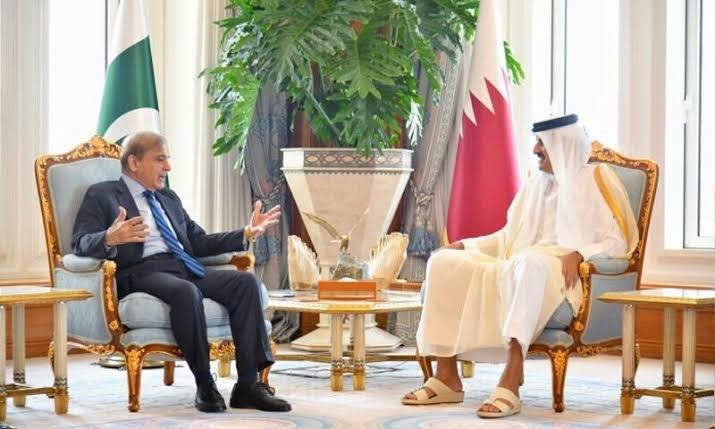
Prime Minister Shehbaz Sharif’s recent visit to Doha has once again highlighted the steady intensification of relations between Pakistan and Qatar, as both nations seek to translate political goodwill into deeper economic and commercial engagement.
The two-day official trip, undertaken at the invitation of the Amir of Qatar, Sheikh Tamim bin Hamad Al Thani, reflects the growing strategic weight Islamabad attaches to its partnership with Doha. Notably, this marks the prime minister’s third visit to Qatar within a span of five months, underscoring a sustained diplomatic focus on strengthening bilateral ties.
During his stay in the Qatari capital, the prime minister held an important meeting with Dr Ahmed bin Mohammed Al-Sayed, Qatar’s Minister of State for Foreign Trade, who also heads the Pak-Qatar Joint Business Taskforce. The discussion centered primarily on enhancing trade volumes, expanding investment flows, and accelerating follow-up actions agreed upon in previous bilateral forums. Senior Pakistani officials, including Deputy Prime Minister Ishaq Dar, Federal Minister for Information and Broadcasting Attaullah Tarar, and Special Assistant to the Prime Minister Tariq Fatemi, were also present, signaling the high-level importance Islamabad attaches to the relationship.
The talks reflected a shared understanding that economic cooperation must now take center stage in the partnership. Both sides expressed satisfaction with the upward trajectory of relations but acknowledged that the existing level of trade does not yet match the broader potential of the two economies.
Prime Minister Shehbaz Sharif emphasized the need to significantly raise bilateral trade volumes and to diversify Pakistan’s export portfolio to the Qatari market. In particular, he highlighted agricultural produce, processed food items, and value-added goods as promising sectors capable of meeting Qatar’s demand while strengthening Pakistan’s export base.
The Qatari side conveyed a clear interest in deepening commercial engagement beyond traditional sectors. Dr Al-Sayed reaffirmed Doha’s readiness to expand cooperation and to foster stronger linkages between the private sectors of both countries.
He underlined the importance of building durable business-to-business connections, which could serve as a long-term foundation for sustained economic collaboration. According to officials familiar with the meeting, there was consensus that facilitating direct interaction between entrepreneurs and investors would be essential to unlocking untapped opportunities.
An important element of the discussion involved the implementation of decisions taken during the sixth session of the Pakistan-Qatar Joint Ministerial Commission. Both governments reiterated their commitment to ensuring that agreed initiatives move forward without delay. The follow-up mechanism, officials noted, is critical to maintaining momentum and translating policy commitments into tangible outcomes.
To this end, it was agreed that the Joint Business Taskforce—comprising relevant officials and stakeholders from both sides—would convene within the month of Ramazan. The purpose of the upcoming meeting will be to evaluate specific investment proposals and identify concrete projects in which Qatari capital could play a transformative role within Pakistan’s economy.
Prime Minister Shehbaz Sharif used the occasion to outline the reforms introduced by his government to create a more welcoming climate for foreign investors. He drew attention to structural improvements aimed at simplifying procedures, enhancing transparency, and ensuring policy continuity.
Particular emphasis was placed on the role of the Special Investment Facilitation Council (SIFC), which has been established to streamline coordination among federal and provincial authorities. The prime minister described the council as a central platform designed to remove bureaucratic hurdles and fast-track large-scale investment initiatives.
The visit also carried broader geopolitical implications. It took place amid evolving regional dynamics, especially developments along Pakistan’s western border. While the meeting’s formal agenda focused on economic matters, the backdrop of shifting regional security conditions lent added significance to high-level diplomatic engagement. Observers note that closer ties with Gulf partners such as Qatar contribute not only to economic stability but also to Pakistan’s broader strategic positioning.
This was not Prime Minister Shehbaz Sharif’s first recent engagement with Qatari leadership. In September, he traveled to Doha twice within a short interval. His first visit was intended to express solidarity with Qatar following Israeli strikes in the region, while the second involved participation in an Arab-Islamic summit hosted in the Qatari capital. Those visits reinforced political alignment and mutual support on regional issues, laying the groundwork for the current phase of intensified economic dialogue.
Qatar has emerged as an increasingly important partner for Pakistan, not only in trade but also in energy cooperation and labor relations. Thousands of Pakistani expatriates reside and work in Qatar, contributing to both economies. Strengthening institutional and commercial ties therefore carries social as well as financial dimensions. By focusing on industrial collaboration, trade expansion, and structured investment mechanisms, both governments appear intent on elevating the partnership to a more comprehensive level.
The tone of the discussions in Doha suggested a pragmatic approach aimed at measurable outcomes. Rather than relying solely on broad declarations, both sides emphasized the importance of actionable steps and clear timelines. The decision to convene the Joint Business Taskforce within Ramazan reflects a desire to maintain urgency and ensure that dialogue is followed by implementation.
Analysts believe that Pakistan’s emphasis on diversifying exports aligns well with Qatar’s strategy of securing reliable food supply chains and exploring new avenues of overseas investment. Agricultural cooperation, food processing ventures, logistics partnerships, and industrial joint ventures are among the areas likely to feature prominently in upcoming discussions. If realized, such initiatives could significantly enhance bilateral trade figures and stimulate economic growth on both sides.
The prime minister’s repeated visits to Doha within a relatively short timeframe illustrate the centrality of Qatar in Islamabad’s foreign policy priorities. The evolving partnership is increasingly framed not just in diplomatic terms but as a strategic economic alliance. As global economic conditions remain uncertain and regional dynamics continue to shift, both countries appear determined to consolidate cooperation through structured mechanisms and sustained political engagement.
The Doha meetings reaffirmed a shared commitment to expanding trade, accelerating investment, and deepening industrial collaboration. With follow-up processes already scheduled and reform initiatives highlighted, the trajectory of Pakistan-Qatar relations appears firmly oriented toward greater economic integration.
Whether measured through enhanced trade volumes, new joint ventures, or strengthened institutional coordination, the partnership is entering a phase defined by practical outcomes and long-term strategic vision.