

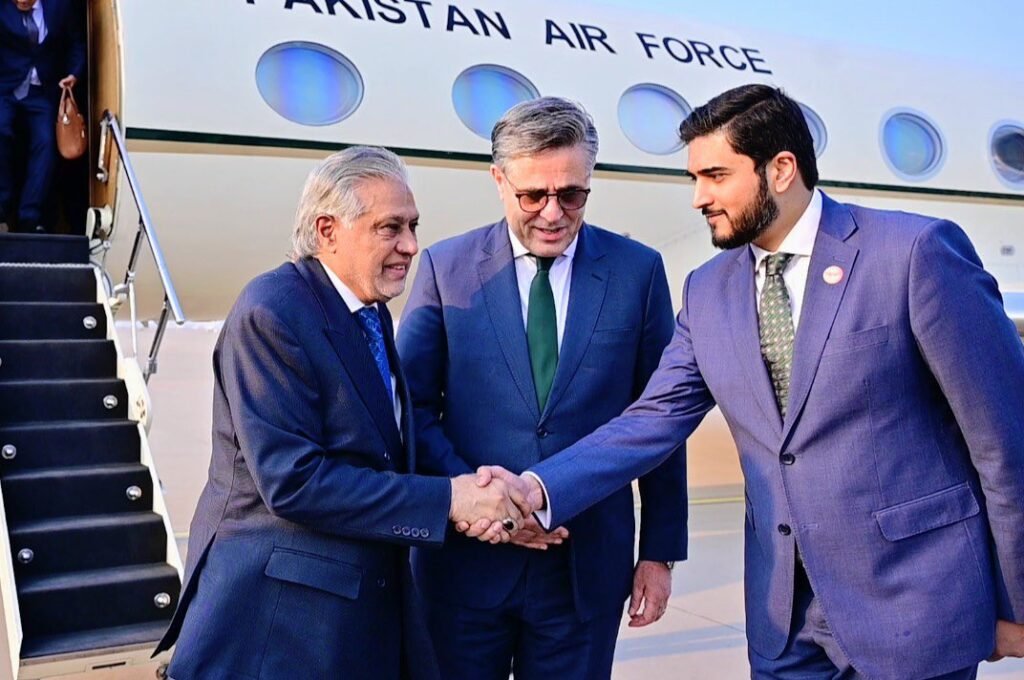
Deputy Prime Minister and Foreign Minister of Pakistan, Ishaq Dar arrived in Beijing on Tuesday for a one-day official visit aimed at reinforcing diplomatic ties and discussing pressing regional concerns, particularly the escalating situation in Iran.
According to a post by Pakistan’s Ministry of Foreign Affairs on social media, the visit was undertaken at the invitation of his Chinese counterpart, Wang Yi, and marks the second visit by Minister Dar to Beijing this year, underlining the ongoing high-level engagement between the two countries.
During his short stay, Minister Dar is expected to hold in-depth discussions with Wang Yi regarding both bilateral and regional matters. The focus of the dialogue includes reviewing the current state of Pakistan-China relations, identifying opportunities for enhancing economic, political, and strategic cooperation, and addressing global issues of mutual interest.
The visit comes at a time when regional tensions, particularly surrounding Iran, have intensified, making diplomatic coordination between Islamabad and Beijing more critical than ever.
The Ministry of Foreign Affairs highlighted that Minister Dar’s engagement in Beijing is part of a broader framework of continuous strategic communication and collaboration between Pakistan and China. The discussions are designed to strengthen mutual understanding, consolidate existing agreements, and explore new avenues for cooperation that could have implications for both countries’ regional and international standing.
Speaking on the visit, Chinese Foreign Ministry spokesperson Mao Ning emphasized that Pakistan and China enjoy an “all-weather strategic cooperative partnership” built on mutual trust and support. She underlined that both nations maintain similar positions on major international strategic issues and engage in regular, high-level communication to ensure alignment on key matters.
Mao further highlighted that the meeting would focus on regional issues of common concern, including the evolving situation in Iran, and expressed confidence that the two foreign ministers would enhance coordination and communication on these challenges.
Mao Ning added that the discussions are expected to emphasize peace, stability, and justice, reflecting the shared commitment of China and Pakistan to promote regional security. By coordinating efforts on contentious regional matters, both countries aim to reduce hostilities, strengthen diplomatic engagement, and advocate for constructive solutions that minimize conflict and encourage stability in neighboring areas.
Beyond the immediate focus on Iran, Minister Dar’s visit is set to cover a broad spectrum of bilateral issues. These include economic cooperation, trade, energy projects, infrastructure development, education, cultural exchanges, and defense collaboration. The dialogue aims to consolidate the substantial progress achieved over past years and to identify future pathways for mutually beneficial projects that align with the strategic priorities of both nations.
Economic collaboration, in particular, is a central aspect of the visit. China and Pakistan have historically maintained strong trade ties, with China acting as a significant partner in Pakistan’s infrastructure development and long-term economic planning. Minister Dar’s meetings with his Chinese counterparts are expected to discuss ways to expand investment, increase trade volume, and explore innovative avenues for joint projects that will benefit both countries.
The visit also underscores the significance of strategic alignment in international forums. Both Pakistan and China have frequently coordinated their positions on critical global issues, demonstrating consistent support for each other’s policies and priorities. This alignment ensures that both nations present a cohesive and cooperative front on diplomatic and strategic matters, enhancing their influence in regional and global decision-making.
Minister Dar’s discussions with Wang Yi are expected to reinforce mechanisms for continuous dialogue, ensuring that both nations can respond promptly to regional developments. The Iranian situation, in particular, requires a coordinated approach to maintain stability, prevent escalation, and support efforts toward peaceful resolution. China’s role as a mediator and strategic partner in regional affairs complements Pakistan’s focus on diplomacy, making these discussions pivotal in addressing emerging challenges.
The fact that this is Minister Dar’s second visit to Beijing this year highlights the intensity and priority of Pakistan-China relations. Regular high-level engagements provide a platform for sustained collaboration and reinforce the shared commitment of both countries to long-term strategic, economic, and diplomatic objectives. These visits also serve to strengthen trust, facilitate direct communication, and allow for candid discussions on sensitive regional issues.
By focusing on both bilateral relations and regional peace, Minister Dar’s visit demonstrates Pakistan’s dual-track approach: deepening strategic and economic partnerships while actively contributing to efforts that prevent conflict and promote stability in its neighborhood. The discussions are expected to yield concrete steps for further collaboration and establish mechanisms for continuous consultation on evolving regional dynamics, particularly in the context of Iran’s geopolitical situation.
China’s recognition of Pakistan as a reliable and strategic partner is central to the visit’s significance. Mao Ning reiterated that the two countries share mutual interests on critical global issues and that cooperation between Beijing and Islamabad is essential for maintaining regional equilibrium. The coordinated approach to both diplomacy and strategic planning provides a foundation for collaborative action on pressing issues that affect peace and stability in South Asia and beyond.
In summary, Ishaq Dar’s one-day official visit to Beijing is a significant diplomatic engagement aimed at strengthening Pakistan-China relations, coordinating strategies on regional issues like Iran, and promoting economic, political, and strategic cooperation. The visit reflects a sustained commitment from both countries to work closely on matters of mutual interest, enhance communication and coordination, and advocate for peace, stability, and constructive solutions in the region.
It further signals to the international community that Pakistan and China are determined to maintain strong bilateral ties while contributing to regional security, economic development, and diplomatic alignment on complex global challenges.
This visit not only reinforces bilateral ties but also serves as a statement of strategic intent, highlighting Pakistan’s proactive approach to diplomacy and regional collaboration, with China positioned as a pivotal partner in these efforts.
With regional tensions remaining a concern, the discussions between Ishaq Dar and Wang Yi are expected to strengthen coordination, enable effective joint responses to emerging issues, and establish a framework for continuous engagement on matters critical to peace, stability, and prosperity in the region.