

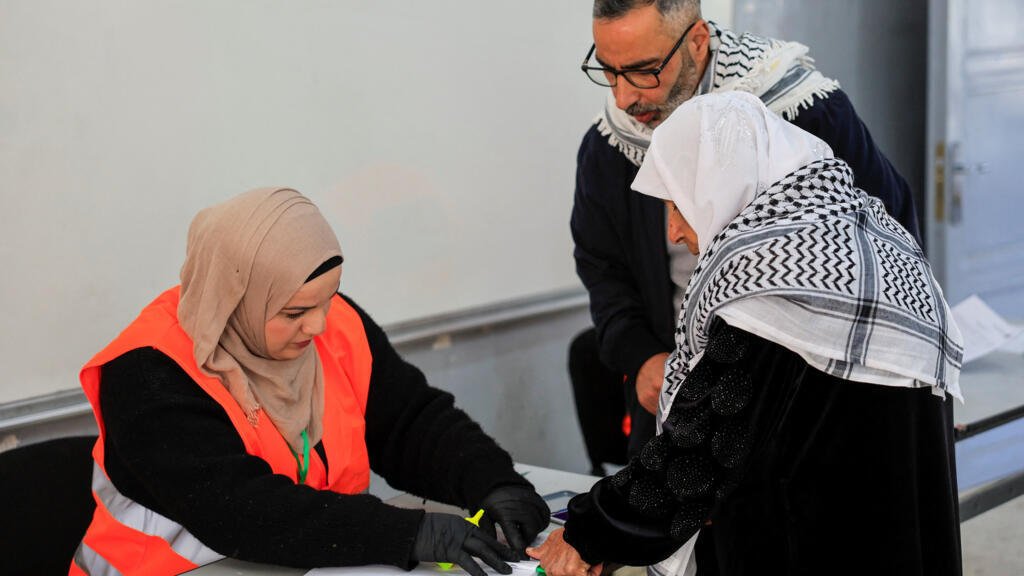
Municipal elections are being held on Saturday in parts of the occupied West Bank and a limited area of central Gaza, marking the first electoral process for Palestinians since the outbreak of the Gaza war. The vote is taking place under highly difficult political and humanitarian conditions, with observers noting a narrow political landscape and widespread public frustration over governance and the ongoing conflict.
According to the Central Elections Commission based in Ramallah, approximately 1.5 million registered voters are eligible to participate across the West Bank, which remains under Israeli occupation. In addition, around 70,000 registered voters are expected to take part in Gaza’s Deir al-Balah region, one of the few areas where local voting is being conducted despite the extensive destruction and instability affecting the enclave.
The electoral competition is largely dominated by lists associated with Fatah, the secular-nationalist political movement led by Palestinian President Mahmoud Abbas, alongside a number of independent candidates. In contrast, Hamas, Fatah’s main rival and the governing authority in most parts of Gaza, is not participating in these municipal elections, and no candidate lists have been submitted under its banner.
In many municipalities, electoral competition is primarily between Fatah-backed groups and independent coalitions that include candidates from smaller political factions. Among these are representatives linked to leftist and Marxist-oriented groups such as the Popular Front for the Liberation of Palestine. This has resulted in a political environment where choices remain limited, and in some cases, voters are presented with only a single list.
In several major cities including Ramallah, which serves as the administrative center of the Palestinian Authority, as well as Nablus, the situation is even more constrained. Only one electoral list has been submitted in these locations, meaning that those candidates will automatically assume office without the need for a competitive vote. This has further contributed to public skepticism regarding the effectiveness of the electoral process.
On the ground, many residents have expressed deep doubts about whether these elections will bring any meaningful improvement to their daily lives. In the northern West Bank city of Tulkarem, where Israeli military presence has been significant for an extended period, local residents describe a sense of political powerlessness. Areas surrounding Tulkarem, including nearby refugee camps, have remained under tight military control for over a year, limiting both movement and civic activity.
Some citizens have voiced the opinion that the electoral process is largely symbolic under current conditions. One local businessman from Tulkarem remarked that regardless of whether candidates are independent or affiliated with political parties, the impact on governance and local services would likely remain minimal. According to such views, the broader political and military situation overshadows municipal governance, making local elections less influential in practice.
He further emphasized that the realities of occupation shape daily life far more than any elected municipal authority. In his view, the elections may serve more as a visual demonstration for international audiences rather than a reflection of genuine political autonomy or statehood. This sentiment reflects a broader sense of disillusionment among segments of the population, particularly in areas heavily affected by conflict and restrictions.
Voting arrangements have been structured differently across regions due to security and infrastructural challenges. In the West Bank, polling stations are scheduled to operate from early morning until evening, allowing voters a full day to cast their ballots. In contrast, in the Gaza area of Deir al-Balah, polling hours are shorter. Authorities have arranged for voting to conclude earlier in the day to ensure that counting can be completed in daylight, a necessity given the widespread electricity shortages and the destruction of public infrastructure in the war-affected region.
The overall electoral process is being overseen by the Central Elections Commission, which has described the logistical effort as complex but necessary under current conditions. Despite the challenges, the commission has continued preparations to ensure that voting proceeds in an orderly manner where possible.
International attention has also been drawn to the elections. A United Nations official responsible for coordination in the region has acknowledged the significance of the process, describing it as a valuable opportunity for Palestinians to exercise democratic participation even during a period marked by severe hardship and instability. The statement highlighted that holding elections under such circumstances reflects both resilience and a continued desire for civic engagement.
However, the broader context remains heavily influenced by ongoing conflict, political division, and humanitarian concerns. The war in Gaza and continuing tensions in the West Bank have created an environment in which normal political activity is significantly disrupted. Movement restrictions, security operations, and infrastructure damage have all contributed to limiting the scope and impact of local governance.
As voting proceeds, the elections are being closely watched as a measure of political sentiment and administrative functionality under extraordinary conditions. While they represent a formal exercise in democracy at the municipal level, many analysts suggest that their broader significance is shaped as much by the surrounding conflict and occupation as by the electoral process itself.