

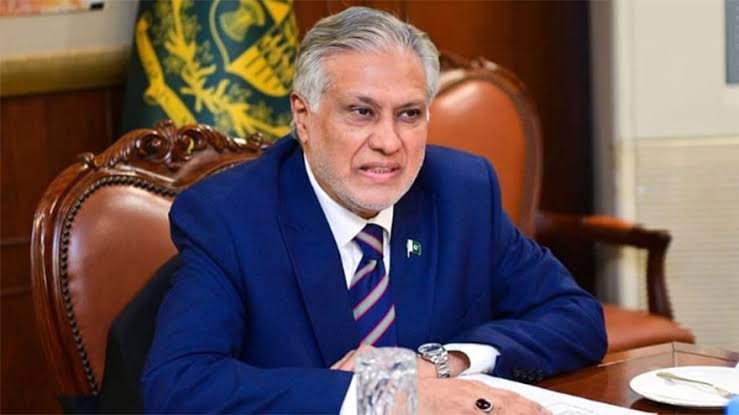
In London, outside the premises of Pakistan’s High Commission, Deputy Prime Minister and Foreign Minister Ishaq Dar delivered an emphatic message about Pakistan’s emerging role in global security affairs. He revealed that following the signing of a historic defense pact with Saudi Arabia, a number of other nations have begun showing serious interest in forging similar arrangements with Islamabad. Dar portrayed this momentum as evidence that Pakistan, after proving its strength in what he called the “Battle of Truth,” is now entering a new phase—one where it can channel its defensive reputation into diplomatic prestige, economic revival, and deeper alliances.
Dar was categorical in addressing skepticism over the pact with Saudi Arabia. He clarified that the agreement had been negotiated on equal footing, with no hidden compromises, and far from generating objections, it has actually sparked curiosity and enthusiasm among other capitals.
According to him, not a single state has formally opposed the pact, while many are now exploring how to establish comparable defense ties with Pakistan. His framing of the issue underscores a desire to transform Pakistan’s image: from being a security-dependent nation to one that serves as a security guarantor and a central participant in regional military frameworks.
The underlying milestone for these statements was the Strategic Mutual Defense Agreement signed between Pakistan and Saudi Arabia in mid-September. Under its provisions, any attack against one of the two signatories will be treated as an assault against both, compelling joint defense measures. This arrangement effectively raises their longstanding cooperation to the level of a formal treaty, drawing parallels to collective defense mechanisms practiced by alliances like NATO.
Pakistani and Saudi officials have since highlighted the pact’s scope, which extends to training, intelligence exchange, deterrence planning, and potential joint operations in times of crisis. Both countries stress that the deal is defensive in nature, intended to safeguard sovereignty and discourage aggression, rather than provoke conflict. For Saudi Arabia, the accord locks in an additional layer of security at a time when the kingdom is recalibrating its regional strategy. For Pakistan, it symbolizes recognition of its military value and opens the possibility of a wider network of alliances.
Yet, while celebrated domestically as a breakthrough, the agreement has generated uncertainty abroad—particularly due to statements by Pakistan’s defense minister hinting that the country’s nuclear deterrent could, in principle, be extended to Saudi Arabia under the pact. Although those remarks were later softened, the ambiguity left room for speculation about whether Riyadh could now benefit from Pakistan’s nuclear umbrella. Analysts caution that such an interpretation could upset delicate balances in the Middle East and trigger reactions from rivals like Iran and Israel, as well as from major powers already entangled in the region.
For Ishaq Dar, however, the London remarks were less about technical details and more about shaping perceptions. By asserting that “many countries” are eager to sign agreements modeled on the Saudi deal, he sought to project Pakistan as a state in demand, a country no longer isolated but increasingly courted for its defensive capabilities. His rhetoric also served a domestic political purpose: to reassure citizens that Pakistan is not only safeguarding its honor but also converting strategic credibility into diplomatic and economic dividends.
This strategic rebranding carries both opportunities and risks. On one hand, Pakistan stands to strengthen its role in the Islamic world by spearheading new security partnerships.
On the other, entangling itself in multiple defense commitments may expose it to conflicts that do not directly serve its national interest. Critics, both at home and abroad, have urged Islamabad to proceed cautiously, warning that expanding such treaties without clear limits could compromise strategic autonomy. Indian commentators, in particular, have already voiced concern, framing the Saudi-Pakistan pact as a development with potentially destabilizing consequences.
The regional backdrop makes these maneuvers even more complex. Gulf states are reassessing their reliance on traditional Western security guarantees, exploring partnerships that offer flexibility and cultural affinity.
Iran has even signaled openness to becoming part of the Pakistan-Saudi defense arrangement, casting the idea as a broader Muslim security compact rather than a narrow bilateral deal. Such overtures, though, raise their own questions: can Pakistan simultaneously manage competing expectations among rivals like Iran and Saudi Arabia without getting caught in cross-currents?
For now, the agreement remains deliberately elastic in its wording—strong enough to affirm solidarity, but vague enough to allow multiple interpretations.
This ambiguity gives Pakistan diplomatic room to maneuver, while also leaving its partners and rivals guessing about the full scope of its commitments. Whether the treaty evolves into a cornerstone of regional defense or remains a symbolic gesture will depend on how both sides operationalize it in the coming years.
At the heart of Dar’s speech was a broader aspiration: to position Pakistan as more than a passive player in global affairs. The defense pact with Saudi Arabia, in his telling, is not an endpoint but a launchpad. If additional countries do indeed formalize similar arrangements, Pakistan could find itself at the center of a new lattice of security partnerships—an evolution with profound implications for its regional and international standing.