

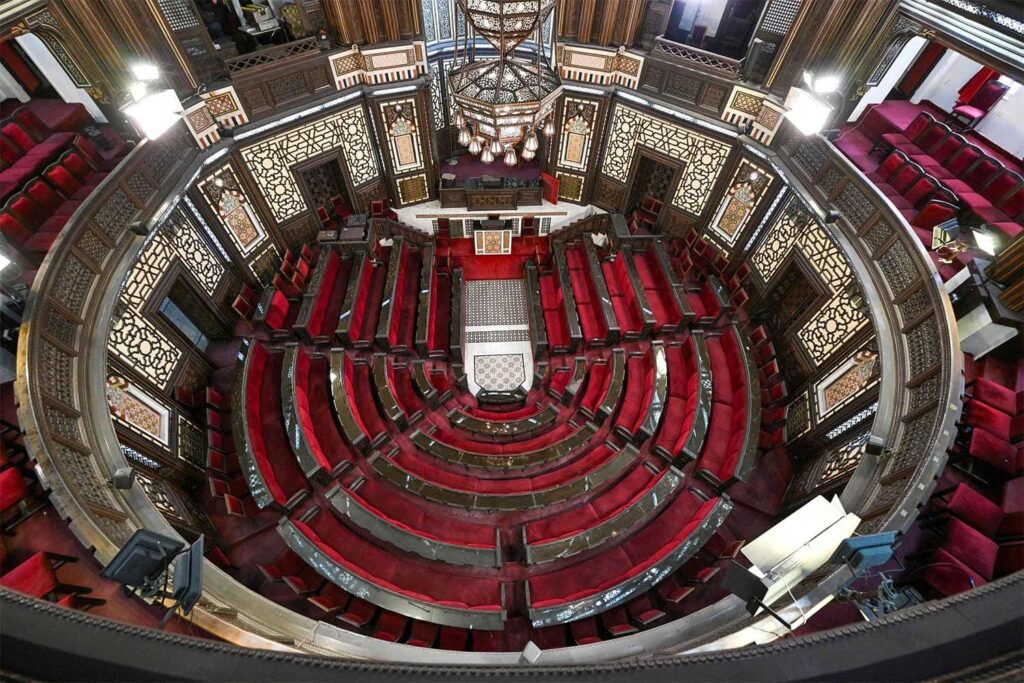
Syria entered a crucial new political chapter this Sunday as thousands of electors across regional councils cast their votes to choose the majority of representatives for the country’s first parliament after the Assad era. The event, regarded as a turning point in Syria’s post-war transition, marked an attempt to formalize governance under interim President Ahmed al-Sharaa’s leadership.
The process began early in the morning and continued until late evening, with around six thousand members of regional electoral bodies participating across several administrative zones. Their task was to elect two-thirds of the upcoming 210-member assembly through an indirect vote, while the remaining one-third of the seats will later be appointed by President al-Sharaa.
This mixed electoral system has been introduced to address the nation’s fractured demographic landscape, as more than a decade of war and displacement has made a universal direct vote impractical. The transitional administration explained that millions of Syrians remain displaced either within the country or abroad, leaving voter registries incomplete and electoral mapping unreliable.
The new parliament will serve a thirty-month term, with the possibility of extension under the provisions of the transitional constitutional declaration issued earlier this year. Once the full chamber is established through both elections and presidential appointments, it is expected to select a new prime minister and review a draft framework for long-term constitutional reform.
A total of 1,570 candidates have been cleared to contest the election, among them a notable number of women — approximately fourteen percent — marking an incremental step toward gender representation in Syrian politics. The candidates spent the past week presenting their platforms through local debates and limited public meetings, although large-scale rallies remained rare due to continuing security restrictions and the uncertain political atmosphere.
Despite official optimism, the process is shadowed by skepticism. Many analysts view this indirect election as a carefully managed transition designed to retain executive control while projecting an image of political renewal. The constitutional rule bars any candidate who has publicly supported the old regime or advocated for territorial division, reflecting the state’s desire to keep the process within specific ideological boundaries.
Voting did not take place uniformly across the nation. Authorities postponed the electoral process in three provinces — As-Suwayda, Raqqa, and Hasakah — citing instability and logistical difficulties. These regions, long affected by insurgent control or inter-factional tensions, will temporarily remain without parliamentary representation, leaving nineteen seats vacant. In some partially stable districts of Raqqa and Hasakah, subcommittees were recently created to hold supplementary local votes once conditions improve.
Security presence was heavy throughout the day, with armed units stationed near polling centers to prevent disruptions. No major incidents were reported, though turnout appeared modest in several towns. Officials emphasized that this vote represents a step toward national normalization, even if the participation rate remains uneven.
The announcement of results is expected within hours, after which President al-Sharaa will appoint the remaining members to complete the legislative body. Once finalized, the assembly will assume responsibility for endorsing interim policies, approving national budgets, and advising the presidency on governance and reconstruction priorities.
Observers see this election not only as a procedural milestone but as a test of whether Syria’s fragmented political landscape can be stitched back together through institutional reform rather than continued division. For ordinary Syrians, many of whom remain displaced or disillusioned, the hope is that this parliament might finally serve as a platform for reconciliation, reconstruction, and a long-awaited return to stability.