

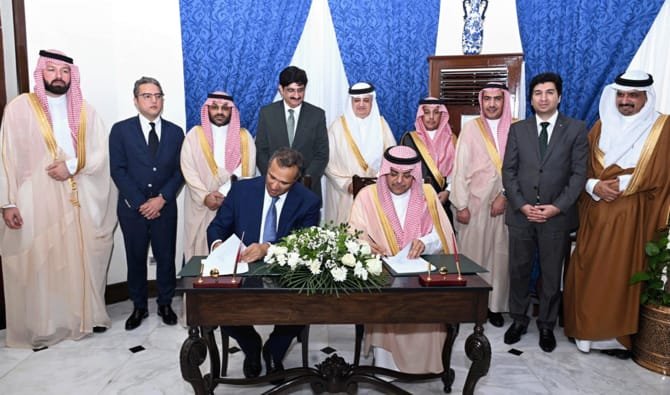
A prominent Saudi business delegation, headed by Prince Mansour bin Mohammed bin Saad Al Saud, is in Karachi for a mission focused on deepening economic cooperation with Pakistan.
Their visit comes against the backdrop of strengthened strategic ties between the two countries, particularly after Pakistan and Saudi Arabia signed a defense agreement that declares an attack on one to be considered an attack on both. During meetings in Karachi, the delegation emphasized interest in investing across multiple sectors including food security, energy, mining, tourism, infrastructure, and privatization. The aim is to forge partnerships that deliver mutual benefits and align with both nations’ economic visions.
During discussions with Sindh’s leadership, Prince Mansour stated that ensuring food security remains the foremost priority. He conveyed that Saudi Arabia’s leadership has directed its business community to engage more deeply with Pakistan’s economy, especially in projects that offer long-term returns.
In addition to food and agriculture, the delegation is looking seriously at energy and gas ventures, mineral extraction, tourism especially in coastal zones, and development of ports, airports, education, and health sectors. They also floated the idea of establishing an institute focused on information technology and emerging technologies to leverage Pakistan’s growing technical workforce.
Sindh Chief Minister Syed Murad Ali Shah welcomed the delegates and underscored his province’s wealth of resources and investment potential.
He pointed out that Karachi contributes roughly thirty percent of Pakistan’s GDP, making the city a focal point for economic activity. He also drew attention to Sindh’s natural endowments: solar and wind energy corridors in Jhimpir and Gharo with capacities exceeding fifty thousand megawatts, one of the world’s largest untapped lignite reserves in Thar, and fertile lands in the Indus Basin producing rice, sugarcane, wheat, and various fruits. Shah suggested that Saudi investment in modern farming, meat and dairy processing, and halal exports could be especially profitable given global demand.
In addition to these sectors, Coastal and heritage tourism, resorts development, and coastal zone enhancement were identified as promising areas. The delegation was shown potential in developing Karachi’s coastal stretch and Balochistan’s beaches, which are among the longest in Pakistan.
Infrastructure investments were also on the agenda: transit-projects such as Karachi’s Blue and Yellow Line, motorways like Hyderabad-Sukkur, and development of Special Economic Zones were offered to Saudi investors. The Sindh government emphasized its commitment to improving land record digitization, simplifying investment procedures, and maintaining a reform-friendly regulatory environment.
Two memoranda of understanding (MoUs) were signed during the visit: one involving the sale and purchase of shares in KES Power Ltd, and another establishing a cooperation framework between K-Electric and Trident Energy Ltd focused on expanding investment in the power sector. These agreements were described as early but symbolic steps toward reinforcing investor confidence in Pakistan’s energy infrastructure, transmission, and generation capabilities. The provincial administration released a statement that the engagements align with Saudi Vision 2030 and Sindh’s long-term growth plan, stressing inclusive and sustainable economic progress.
The delegation, besides Karachi, is meeting provincial governments and private sector players in various cities including Lahore, aiming to explore public-private partnership opportunities. There is intent to set up joint working groups in priority sectors so that action items discussed now can lead to consistent follow-ups. The collaboration will be supported from start to finish: from feasibility studies to actual implementation of projects, ensuring investor risk is mitigated by clarity, policy stability, and facilitation.
At a national level, Pakistan has recently formed an eighteen-member committee tasked with guiding economic engagements and negotiations with Saudi Arabia.
This committee is co-chaired by the Climate Change Minister and the National Coordinator for the Special Investment Facilitation Council (SIFC), with members including ministers responsible for food security, power, commerce, technology, and communications. The government has instructed that proposals involving travel by committee members between Pakistan and Saudi Arabia be processed rapidly—on the same day—signaling urgency and seriousness in these bilateral interactions.
Observers point out that Saudi Arabia’s interest is not new but is being formalized now into more structured investment channels. Private businesses from Saudi Arabia already have linkages in Pakistan, but what is changing is the depth and breadth of engagement. Investment in infrastructure, energy, mining, agriculture, tourism, and technology reflects a shift toward more capital-intensive and strategic projects. The focus on coastal development and tourism suggests an understanding of Pakistan’s comparative advantages in its geography and cultural heritage.
Sindh’s leadership sees these developments as a chance not just to attract foreign capital but to transform sectors, generate jobs, and uplift communities.
They believe that leveraging strong institutional cooperation, policy reforms, and streamlined investment mechanisms will help ensure that projects are brought online, benefit local populations, and contribute to sustainable growth. The government is emphasizing that it wants projects with clear returns, transparency, and international best practices, especially in sectors like energy where costs, environmental impacts, and regulatory risk are significant.
Key challenges remain. Investors typically seek regulatory stability, clarity about land rights, speed in approvals, protection from policy reversals, access to infrastructure, and assurance of returns.
Sindh has committed to digitizing land records and simplifying bureaucratic processes, which is seen as steps in the right direction. Coordination between provincial authorities and federal bodies like SIFC, Trade Development Authority, and Ministry of Commerce is also being enhanced to address investor concerns. There is also talk of marrying domestic reforms with international standards so that projects in Pakistan are attractive not only to Saudi investors but also fit global investment and financing norms, including environmental, social and governance (ESG) standards.
In summary, the Saudi delegation’s visit signals a decisive push toward stronger economic integration between Pakistan and Saudi Arabia, beyond traditional trade and energy transactions.
Food security, energy, mining, coastal tourism, and privatization are emerging as key sectors where collaboration could yield significant benefits. With policy reforms, institutional support, memoranda in place, and agreements to follow, both sides appear committed to converting these discussions into tangible projects. If the momentum is maintained, Pakistan—especially Sindh—and Saudi investors may jointly foster a transformation in sectors that matter for jobs, stability, and regional prosperity.