

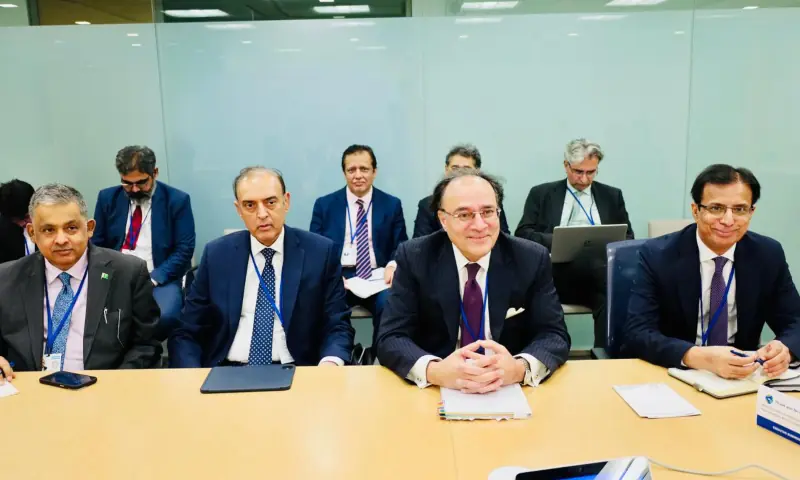
Finance Minister Muhammad Aurangzeb confirmed that Pakistan is set to finalize a staff-level agreement (SLA) with the International Monetary Fund (IMF) within the week. Speaking to Reuters on the sidelines of the IMF–World Bank Annual Meetings in Washington, he said, we’re hoping to get the SLA done during the course of this week. The deal will unlock a crucial $1.24 billion tranche under the IMF’s $7 billion Extended Fund Facility (EFF) and $1.1 billion Resilience and Sustainability Facility (RSF).
An IMF mission led by Iva Petrova concluded two weeks of talks in Islamabad last week, reviewing Pakistan’s economic reforms and fiscal targets. While the team departed without signing the SLA, both sides noted significant progress. Aurangzeb said the discussions focused on quantitative and structural benchmarks, adding that follow-up talks were underway to finalize the review.
Aurangzeb met IMF’s Jihad Azour, Director for the Middle East and Central Asia, where both reaffirmed their commitment to sustaining reform momentum and macroeconomic discipline. He also held delegation-level meetings with World Bank Senior Managing Director Axel van Trotsenburg, stressing the urgent need for climate resilience investments following devastating floods that severely impacted Pakistan’s agricultural output and GDP growth.
The finance minister also engaged with key international stakeholders, including the US-Pakistan Business Council, Citi Bank, IFC, and the Islamic Development Bank, highlighting Pakistan’s stabilizing macroeconomic outlook and growing potential in digital finance, energy, mining, and agriculture. Aurangzeb assured foreign investors of a business-friendly environment, emphasizing the government’s resolve to attract investment and accelerate growth through structural reforms.
Aurangzeb’s visit to Washington, from October 13–18, marks a pivotal phase in Pakistan’s efforts to stabilize its economy and rebuild investor confidence. He attended multiple global forums, including the Commonwealth Finance Ministers’ Meeting, where he advocated for climate financing and the operationalization of the Loss and Damage Fund. The finance ministry said the engagements reflect Islamabad’s “determination to deepen international cooperation, strengthen ties with financial institutions, and transition from stabilization to sustainable and inclusive growth.
As Pakistan edges closer to signing the IMF staff-level agreement, Aurangzeb’s high-level engagements in Washington signal renewed confidence in the country’s reform path. With macroeconomic discipline, investor outreach, and climate resilience at the forefront, Pakistan is aiming not just for stability but for a sustained and self-reliant economic recover