

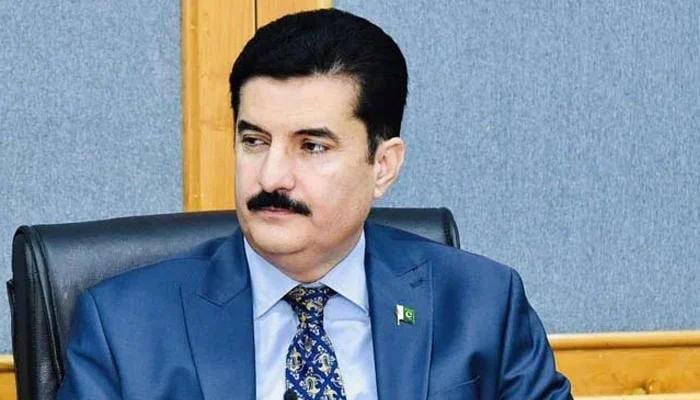
Governor Faisal Karim Kundi of Khyber Pakhtunkhwa arrived at the Governor House in Peshawar on Monday evening, where he is expected to administer the oath of office to the newly elected Chief Minister, Sohail Afridi. This development marks the culmination of days of political uncertainty following the resignation of former Chief Minister Ali Amin Gandapur and the subsequent election held amid legal and political disputes.
Speaking to journalists after his arrival, Governor Kundi addressed the controversy surrounding Ali Amin Gandapur’s resignation, saying that several doubts and procedural complications had emerged in the process. He explained that Gandapur’s first resignation letter arrived late and created confusion, while the second version reached his office before the first one was officially received. These inconsistencies, he said, led to unnecessary delay and speculation. The governor added that Sohail Afridi’s election was conducted according to the constitutional framework, and that the newly chosen leader had secured the support of 90 members of the provincial assembly — a clear majority reflecting the confidence of the house.
Earlier in the day, Pakistan Peoples Party (PPP) Chairman Bilawal Bhutto Zardari had instructed the governor to immediately leave Karachi for Peshawar and comply with the Peshawar High Court’s directive regarding the oath-taking ceremony. During a speech at a private event in Karachi, Bilawal, who was addressing Faisal Karim Kundi directly from the stage, said that the governor should ensure that no constitutional lapse occurs in Khyber Pakhtunkhwa. He added humorously yet firmly that he would ask Sindh Chief Minister Murad Ali Shah to lend his private jet to the governor so that he could fly without delay and fulfill his constitutional duties.
Following the party chairman’s instructions, Governor Faisal Karim Kundi immediately began preparing for his departure to Peshawar. He later spoke to the media, emphasizing that he had never refused to administer the oath to the new chief minister. “I have always maintained that the Constitution and the law must be upheld. My response has already been submitted to the High Court, and I will be in Peshawar tonight to perform my constitutional responsibility,” he said.
Kundi also clarified that provincial governors do not have access to an official aircraft for such travel, which is why he had requested assistance from the Sindh Chief Minister.
He remarked that this cooperation between provinces demonstrated a spirit of constitutional harmony rather than political rivalry. When a journalist asked about his private exchange with Bilawal Bhutto Zardari during the Karachi event, Kundi smiled and replied that such personal discussions were not meant for public disclosure, adding that “some conversations remain between colleagues.”
The recent political events in Khyber Pakhtunkhwa have unfolded rapidly. Former Chief Minister Ali Amin Gandapur resigned from his position last week in compliance with the directions of PTI founder Imran Khan, who reportedly sought to reorganize the party’s provincial leadership. However, Governor Kundi did not immediately approve Gandapur’s resignation, citing the ambiguities surrounding its submission and timing.
Amid this delay, the provincial assembly convened and elected Sohail Afridi as the new Chief Minister. The voting session was boycotted by opposition parties, who termed the process unconstitutional and declared their intention to challenge the election in court. The situation escalated when the Peshawar High Court reserved its verdict on a petition seeking immediate action for the oath-taking of the newly elected chief minister.
On Monday, the court finally issued its decision, directing Governor Faisal Karim Kundi to administer the oath to Sohail Afridi no later than 4 p.m. on October 15. The court made it clear that if the governor failed to fulfill this constitutional duty, the Speaker of the Khyber Pakhtunkhwa Assembly would be authorized to conduct the oath-taking ceremony in his place. The ruling underscored the judiciary’s insistence on maintaining constitutional continuity and preventing any administrative vacuum in the province.
As the political stage in Khyber Pakhtunkhwa shifts once again, all eyes are now on the upcoming ceremony at the Governor House. It will not only mark the formal beginning of Sohail Afridi’s tenure but also symbolize a renewed test of political stability and governance in a province long familiar with political turbulence.