

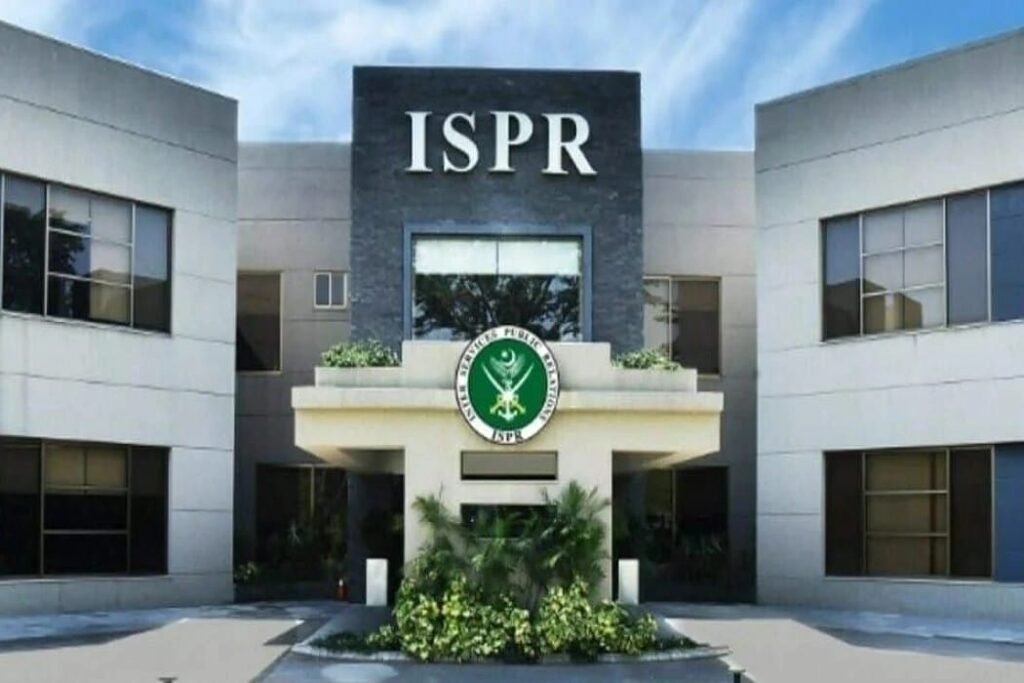
The Inter-Services Public Relations (ISPR) of Pakistan issued a strongly worded statement today, expressing grave concern over India’s renewed wave of provocative propaganda coinciding with the upcoming elections in Bihar and West Bengal. The statement asserted that India, five months after its defeat in the “Battle of Haq,” has once again resorted to distorting facts and fabricating a Bollywood-style narrative aimed at misleading its citizens and the global audience for domestic political gains.
According to the ISPR, the recent remarks by Indian military and political leadership are filled with contradictions and inaccuracies so glaring that responding to them in detail would be unnecessary.
The statement emphasized that this campaign appears to be a deliberate attempt to rewrite history and manipulate public perception, serving a purely political agenda rather than a factual or strategic purpose. Pakistani officials viewed these statements as part of an ongoing pattern where India uses its armed forces’ rhetoric to gain electoral mileage whenever state-level polls draw near.
The ISPR further noted that India’s military spokespersons, particularly during their press conferences, have tried to glorify fabricated claims related to the skirmishes in May, alleging that more than a hundred Pakistani soldiers were killed and that Pakistan’s air bases and ground assets suffered significant damage. These assertions, the ISPR said, are baseless, exaggerated, and detached from reality. The statement underlined that the Indian military’s version of events not only lacks evidence but also exposes their discomfort in accepting the clear outcome of those engagements, where Pakistan’s defense forces demonstrated superior preparedness and resilience.
Pakistan’s military spokesperson highlighted that similar hostile acts have recently been attempted along the border near Kurram, where elements linked with cross-border provocations tried to test Pakistan’s defenses.
However, the Pakistani forces, displaying courage and professionalism, swiftly thwarted these attempts. The retaliation, according to reports, inflicted heavy losses on the aggressors, with several of their posts and armored vehicles destroyed and many militants neutralized or severely injured.
The ISPR also drew attention to the political dimension of these actions, pointing out that the Indian leadership tends to escalate anti-Pakistan sentiment each time national or regional elections approach. By invoking threats and false war stories, the Indian establishment aims to rally domestic voters through hyper-nationalism. This strategy, the ISPR warned, risks igniting unnecessary tensions in South Asia and could trigger a dangerous chain reaction that threatens the region’s fragile peace and stability.
In its detailed statement, the ISPR observed that the international community has started recognizing India as a destabilizing actor rather than the victim it pretends to be.
The statement noted that the world now increasingly views India as a source of cross-border terrorism and as a regional power pursuing policies of coercion and domination against its neighbors. Such actions, it said, are damaging not only to bilateral relations but also to India’s own credibility and long-term interests.
Reaffirming Pakistan’s unwavering commitment to national defense, the ISPR reiterated that the people of Pakistan and its armed forces stand fully prepared to defend every inch of the nation’s borders. Any aggressive move from across the border would be met with an immediate, decisive, and powerful response — one that would be remembered for generations. The statement underscored that Pakistan’s readiness is not rhetorical but rooted in continuous training, vigilance, and operational preparedness.
The ISPR reminded India that hollow boasts and baseless claims might serve short-term political purposes but cannot alter strategic realities. Professional military officers understand, the statement said, that irresponsible posturing and reckless rhetoric can lead to miscalculations and even open conflict. The ISPR stressed that such conduct from Indian leadership not only reflects poor judgment but also endangers regional security and global peace.
In addition, the statement recalled that Pakistan’s senior military leadership had already cautioned New Delhi last week that if India’s policymakers continue to chase the illusion of a “new normal” in bilateral ties — one that disregards respect, sovereignty, and balance — then Pakistan would establish a “new normal” of its own, defined by firm and immediate responses to any provocations.
The ISPR urged India to abandon the politics of provocation and the obsession with rewriting history. It appealed to the international community to take note of the dangerous rhetoric being fueled by New Delhi for domestic political advantage, warning that such behavior could easily spiral into conflict with consequences beyond anyone’s control.
In conclusion, the statement reaffirmed that Pakistan seeks peace but will never compromise its sovereignty or national dignity. Any misadventure, no matter how minor, will be met with a response so swift and decisive that it will serve as a permanent reminder of Pakistan’s resolve and capability. The ISPR called upon India to act responsibly, to respect historical truths, and to recognize that stability in South Asia requires restraint, honesty, and genuine commitment to peace — not political theater staged at the cost of regional security.