

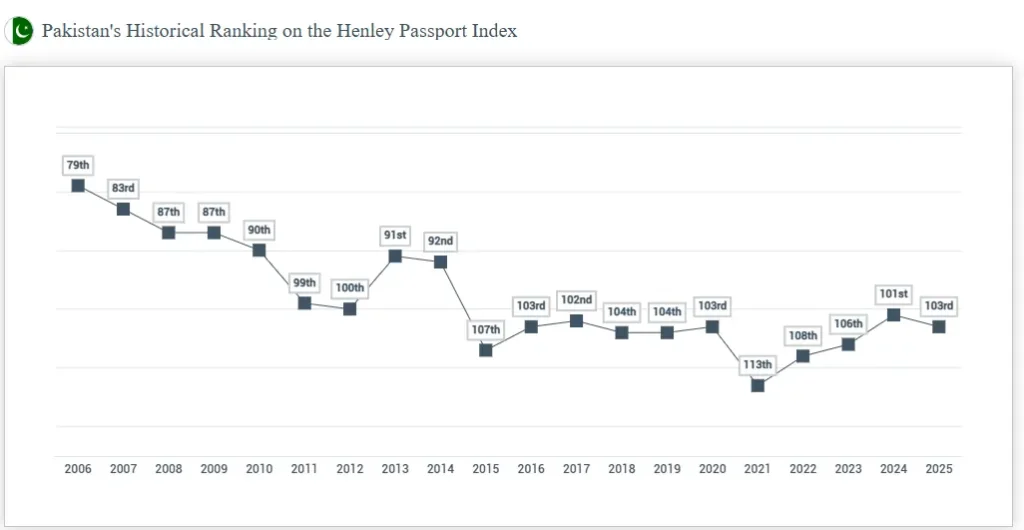
ISLAMABAD: Pakistan’s passport has once again been ranked among the world’s weakest, placing fourth from the bottom in the latest Henley Passport Index 2025, marking the fifth consecutive year of its dismal standing.
According to the index released on October 7, Pakistan was ranked 103rd out of 106 countries, tied with Yemen, and placed higher only than Iraq (104), Syria (105) and Afghanistan (106). Holders of Pakistani and Yemeni passports can travel visa-free to just 31 destinations out of a total of 227 listed by Henley & Partners the London-based global citizenship consultancy that compiles the rankings.
In comparison, Iraq’s passport grants visa-free access to 29 countries, Syria’s to 26, and Afghanistan’s to just 24 destinations. Pakistan has consistently appeared among the lowest-ranked passports since 2021, reflecting continued travel restrictions and limited bilateral mobility agreements.
Historically, Pakistan’s position has fluctuated only marginally ranked 100th in 2023 and 2024, 109th in 2022, and 107th in 2021 with its visa-free score remaining stagnant around 31–32 destinations.
At the other end of the spectrum, Singapore retained its top position for 2025, offering citizens visa-free access to 193 countries, followed by South Korea (190) and Japan (189). Germany, Italy, Luxembourg, Spain, and Switzerland jointly ranked fourth with access to 188 destinations, while Austria, Belgium, Denmark, Finland, France, Ireland, and the Netherlands followed closely with 187.
In a surprising shift, the United States once the top-ranked passport in 2014 fell outside the global top ten for the first time, slipping to 12th place with visa-free access to 180 destinations, tied with Malaysia. Similarly, the United Kingdom dropped to its lowest-ever position, ranking eighth, while the United Arab Emirates continued its ascent, moving up to eighth place with 184 visa-free destinations.
Meanwhile, China’s passport dropped from 59th to 64th, with its visa-free score declining from 85 to 82 destinations, underscoring how diplomatic mobility remains tightly linked to global political and economic alignments.