

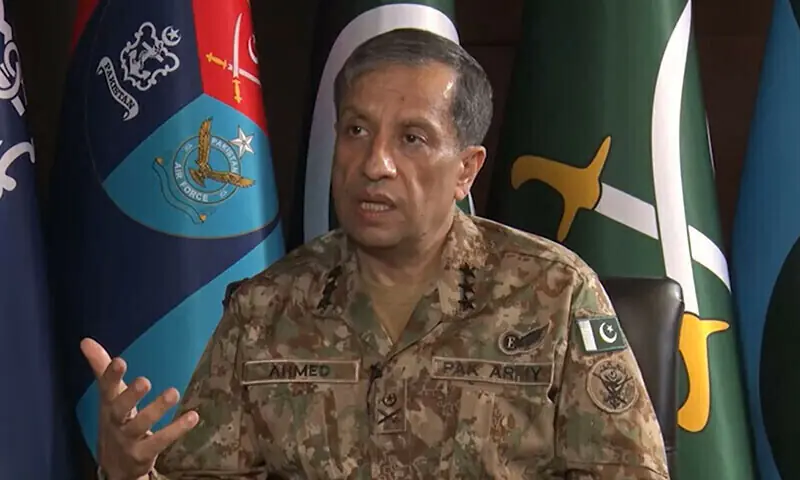
ISLAMABAD: Director-General Inter-Services Public Relations (ISPR) Lieutenant General Ahmed Sharif Chaudhry declared on Monday that the conditions set by Afghanistan hold no significance, emphasizing that for Pakistan, only the eradication of terrorism matters.
In a closed-door briefing to senior journalists in Peshawar, the military’s spokesperson said that Pakistan’s armed forces remain the ultimate guarantors of national security, and not Afghanistan. We never celebrated the arrival of the Taliban, he asserted, underscoring that Islamabad’s focus is on neutralizing threats emanating from across the border rather than engaging in rhetoric.
The statement came days after Pakistan and Afghanistan agreed to an immediate ceasefire during high-level negotiations in Doha on October 19. Both countries pledged to respect each other’s sovereignty and reconvened for a second round of talks in Istanbul on October 25, aimed at developing a “concrete mechanism” to monitor Taliban actions against cross-border terrorism.
In Istanbul, the Afghan Taliban were clearly told they need to control terrorism, Lt Gen Chaudhry said. How they do it is their internal matter. Terrorists who fled from our counterterrorism operations into Afghanistan must be handed over we will deal with them according to our Constitution and the law. He made it clear that Pakistan will hold no dialogue with terrorists and added that a befitting response had already been given to the Afghan Taliban, achieving the results Islamabad desired.
The DG ISPR disclosed that over 1,667 terrorists, including members of banned outfits such as the Tehreek-i-Taliban Pakistan (TTP) and the Balochistan Liberation Army (BLA), were killed in recent operations. He warned of the nexus between drug traffickers and terrorists, revealing that opium cultivation alone generates between Rs1.8 and 2.5 million per acre for these networks. “Entire communities, even warlords, get involved,” he said, adding that Afghan drug smugglers are also influencing Afghan politics.
Veteran journalist Hamid Mir, who attended the briefing, said journalists were shown concrete evidence of Afghan Taliban soldiers involved in terrorist activities within Pakistan. We were presented with the same evidence that had earlier been shared with the Afghan Taliban in Doha, Mir told Geo News, adding that the individuals carried Afghan Army identification cards.
The remarks follow a tense few weeks between Islamabad and Kabul marked by border clashes, accusations, and counter-allegations. The escalation began after an October 11 attack on Pakistan from Afghan territory, which the Taliban claimed followed airstrikes by Pakistan an allegation Islamabad has neither confirmed nor denied.
Pakistan has consistently demanded that Afghanistan ensure its soil is not used by militant groups targeting Pakistan, a charge the Taliban routinely reject. In response to recent attacks, Islamabad reportedly carried out targeted strikes on Gul Bahadur group camps inside Afghanistan, signaling a tougher stance.
After multiple skirmishes, Türkiye and Qatar helped mediate talks that led to the temporary ceasefire in Doha. The Istanbul dialogue, seen as a crucial follow-up, is expected to shape future cooperation mechanisms for cross-border security and counterterrorism coordination.