

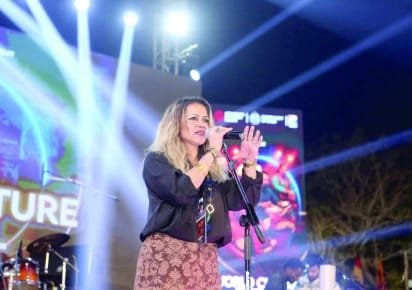
In the bustling halls of the Arts Council of Pakistan, Karachi, a grand celebration of creativity is unfolding, as the annual World Culture Festival brings together talents from more than 140 nations who are showcasing their art, music, dance and heritage. Amid this swirling international energy, one development has particularly captured attention: the long-awaited return of artists from neighbouring Bangladesh after an absence of eighteen years.
The arrival of Bangladeshi performers has added a fresh, emotionally rich dimension to the festival. Among them, acclaimed singer Shireen Jawad enchanted audiences with her lyrical range and emotive delivery. It was her first ever journey into Pakistan, yet she said the warm reception made her feel immediately at home: “Landing here felt like coming back to my own country,” she reflected. Her comments painted a vivid picture of cross-border camaraderie, as she praised the “kind, expressive and helpful” nature of the people she encountered.
Jawad described how she initially planned to render a Sufi piece but, at the suggestion of the festival organisers, opted instead to perform a Bengali track and a romantic composition titled “Mathawali” — a piece about the moon, love and reflection. Her set came across as symbolic: an overdue reconnection between artists and audiences across the region. “I do wonder why it took us eighteen years,” she remarked, noting that what matters is the fact that the moment is finally here.
Visual art also plays a prominent role in this narrative of cultural re-engagement. Bangladeshi artist Neharika Mumtaz used her collection to explore themes of Bangladeshi heritage, womanhood and traditional motifs, deploying vibrant strokes and conceptual layers to tell a story that resonated with Karachi’s spectators. She described the invitation from the Arts Council as a “welcome opportunity” to present Bangladesh’s rich creative diversity on Pakistani soil.
This cultural bridge is not built solely on the arrival of Bangladeshi artists, however. Organisers confirmed that additional performers including Suborna Morsheda, Faria Chowdhury, Shambhu Acharya and Bubly Barna will soon take the stage, representing a spectrum of music, dance and visual practices. Together, their participation signals a revival of cultural exchange, after Pakistani designers recently brought their works to Dhaka, hinting at a two-way traffic of artistic dialogue.
From the opening night onward, global and local artistry have mingled seamlessly. The festival roams through corridors where the duets of opera meet the dynamic surge of local performances; where visual installations converse with rhythm and theatrical narrative. At every turn, the crowd is drawn deeper into a vivid celebration of expression—one that speaks of difference and unity in equal measure.
As the festival advances, the President of the Arts Council, Ahmed Shah, shared in a media interview that each act echoes a broader truth about shared humanity. He emphasised that the event is more than entertainment—it is “a testament to the ability of art to bridge gaps, inspire understanding, and foster unity in a world enriched by diversity.” In his words, this gathering of artists from around the globe reflects the Council’s ongoing commitment to cultural diversity and international connection, proving that art can educate, inspire and draw people together in ways diplomacy alone sometimes cannot.
On one of the festival’s evenings, the local theatre scene held the spotlight with the play “Flirts” — a gripping production that, according to Shah, enthralled audiences with sharp wit, compelling narrative and stellar performances. The theatre’s presence affirmed that while the festival bears an international face, it remains rooted in Karachi’s vibrant arts community.
For many of the attendees, the most compelling takeaway is the reminder of what art can achieve: dialogue where language fails, connection where borders persist, and unity where divisions linger. In an age where geopolitical complexities often dominate relations, the festival offers a refreshing counter-narrative: that creativity and culture can open doors, soften divisions and build new pathways of collaboration.
In every corner of the Arts Council—from the grand auditorium to intimate gallery spaces—the festival has become a living canvas of human expression. More than 140 nations’ artists convene here, packing into music, theatre, dance and fine arts a message of togetherness and renewal. The return of Bangladeshi talent adds a tone of historic reconnection, while the wider pool of artists reminds us that cultural engagement can be global, inclusive and transformative.
This edition of the World Culture Festival promises not just a sequence of performances but a lasting impact on Karachi’s cultural ecosystem. As the festival continues to dazzle audiences with its breadth and depth, it will no doubt leave footprints of inspiration across the city—while fostering relationships that extend well beyond the stage, across borders and into the future.