

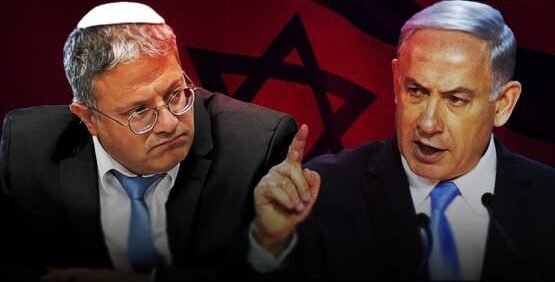
In recent weeks, Israel’s internal political arena has once again been shaken by fierce criticism coming from two of the country’s most hardline right-wing ministers. Finance Minister Bezalel Smotrich and National Security Minister Itamar Ben-Gvir — both known for their uncompromising ideological views — have intensified their public opposition to any international initiative that seeks to grant formal recognition to a Palestinian state. Their statements have not only targeted global actors but have also turned inward, placing Prime Minister Benjamin Netanyahu under exceptional pressure.
Smotrich, speaking through a lengthy message on social media platform “X,” accused Netanyahu of failing to act with the decisiveness he had previously promised. He reminded the prime minister that when a group of countries announced unilateral recognition of Palestine, Netanyahu vowed a strong and immediate reaction. Yet, according to Smotrich, more than two months have passed with “no action, no policy shift, and no national firmness.” He described Netanyahu’s silence as “political humiliation” and argued that such passivity undermines Israel’s credibility at a time when clarity is crucial. He urged Netanyahu to adopt an unmistakably harsh response that would convince the world that the establishment of a Palestinian state is an impossibility from the Israeli perspective.
Ben-Gvir’s criticism took an even sharper tone. Addressing his followers online, he repeated his long-standing claim that the “Palestinian people” are not a legitimate historical nation and that their identity lacks authentic roots. According to him, granting Palestinians statehood would amount to rewarding violence. For the Gaza Strip, he proposed what he called a “voluntary relocation” strategy — a concept long rejected internationally — instead of any political arrangement or diplomatic track. Ben-Gvir also asserted that his party, Otzma Yehudit, would withdraw from any governing coalition that accepted the notion of Palestinian statehood in any form. He demanded that Netanyahu issue a clear and final declaration against such recognition so the coalition’s ideological boundaries remain firm.
Their intensified rhetoric comes at a moment when the global landscape is shifting. A large majority of United Nations member states — reportedly around 160 — now recognize Palestine as a state, and several countries renewed or formalized this recognition during recent UN sessions. The renewed momentum, especially amid the ongoing Gaza conflict, has reignited passionate debate within Israel’s political establishment. Smotrich and Ben-Gvir insist that international decisions do not alter Israel’s right to determine its own security and territorial policies, but their arguments reflect deep anxiety over changing diplomatic currents.
Adding to the tensions, Smotrich has recently unveiled a significant expansion plan for Israeli settlements in the occupied West Bank. The project, in his words, aims to create “facts on the ground” that will permanently block any future attempt to implement a two-state resolution. He believes that increasing settlement density, authorizing new construction, and reinforcing Israeli administrative control in the region are essential steps to safeguarding what he views as Israel’s historic and biblical claim to the land. His announcement triggered sharp reactions not only from Palestinians but also from international observers who see such moves as deliberate efforts to prevent meaningful negotiations.
These statements and actions are unfolding against the background of a long-standing dispute over territories occupied by Israel since 1967, including East Jerusalem — areas that the United Nations and most of the world consider illegally occupied under international law. Despite decades of resolutions and diplomatic initiatives, Israel has maintained military and administrative control over the West Bank and has resisted demands for withdrawal or the establishment of an independent Palestinian state.
The renewed controversy shows how fragmented Israel’s ruling coalition truly is. While Netanyahu’s Likud party has historically supported the possibility of annexing parts of the West Bank, recent U.S. objections and international diplomatic pressure have forced Netanyahu to soften his public position. This shift infuriated Smotrich and Ben-Gvir, who view any hesitation as betrayal of their nationalist platform. The two ministers have now positioned themselves as defenders of ideological purity, portraying Netanyahu as a leader who bends to external influence rather than assert Israeli dominance.
All of this highlights a larger battle within Israeli politics — a tug-of-war between ideological hardliners determined to block Palestinian sovereignty at any cost and a prime minister trying to maneuver through unprecedented global pressure, coalition fragility, and a volatile regional conflict. As the international community edges closer toward collective recognition of Palestine, Israel’s internal divisions become more pronounced, revealing how political survival, national identity, territorial claims, and diplomatic realities are colliding in a single, intense moment of history.